To grow any business, it is essential to keep pace with market trends and changes. But how can you ensure you don’t miss out on these changes and stay in tune with your customers? That is exactly what we will be discussing in this article.
Market research refers to systematic activities that provide the marketing department with the information needed to develop a marketing strategy and select tactics.
To ensure that market research yields the greatest possible benefit, in this article, we will explore the following topics:
- types of research;
- the regularity of the research;
- research findings: how to use the information obtained;
- what research businesses should carry out.
Types of research
There are two types of research: quantitative and qualitative.
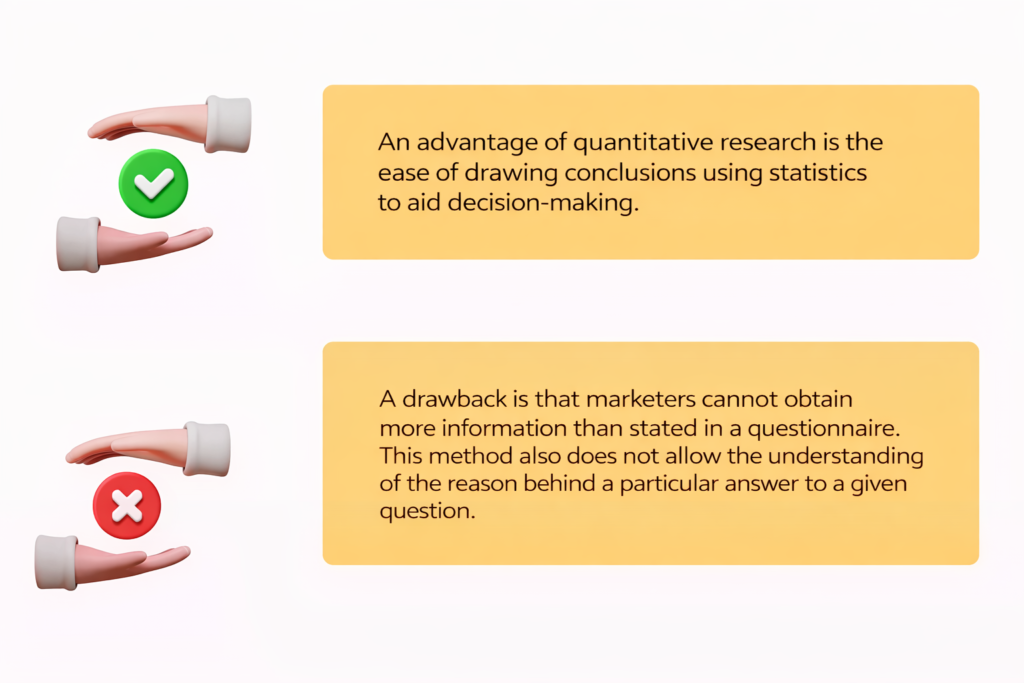
Quantitative research is conducted using a standardised instrument (a questionnaire), in which respondents answer clearly formulated questions. Particular attention is paid to the design of such a questionnaire, as it is the respondents’ answers that serve as the basis for measurement in quantitative research. Incorrect questions lead to incorrect research conclusions.
Research can be conducted using various methods: completing a questionnaire in-store when consumers are offered a choice of products or designs, telephone surveys, filling in forms on websites, and so on.
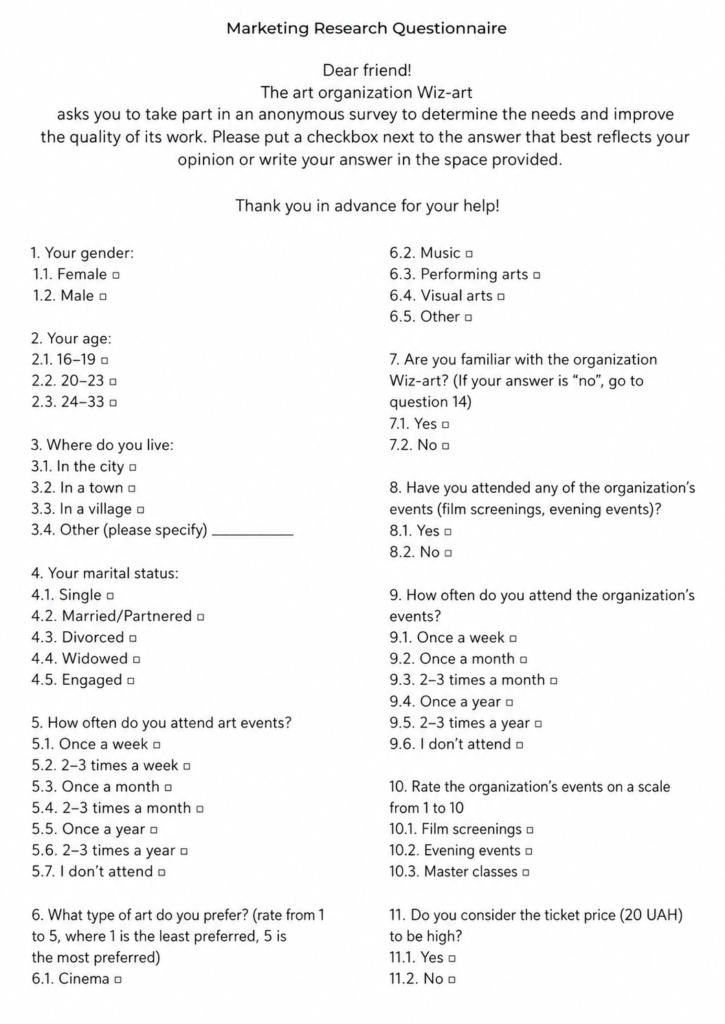
Here are a few examples of questionnaires:
1. Анкета маркетингового дослідження компанії Wiz-art.
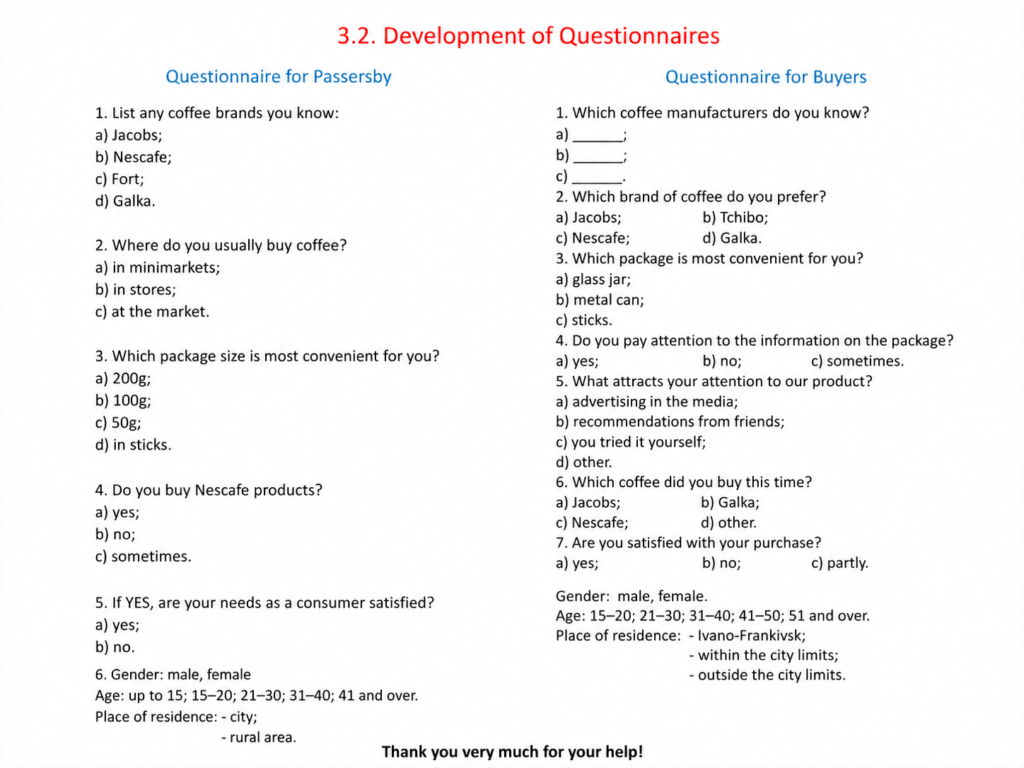
2. Nescafé marketing research questionnaire.
Qualitative research, whilst structured in form, involves dialogue or discussion with respondents on a given topic. Therefore, the moderator — the person conducting the interview — plays a key role in qualitative research, particularly their communication skills, ability to understand respondents, and capacity for empathy.
Qualitative research is also divided into direct and indirect methods.
Direct methodsprovide respondents with information about the research in which they are participating and are carried out using two approaches: focus groups and in-depth interviews. The difference lies in the fact that for a focus group, a sample of 5–10 respondents is selected, whereas in-depth interviews are conducted on an individual basis.
When preparing for an interview, preparing questions plays a key role.
Questions should not prompt respondents to answer “yes” or “no”; your aim is to encourage a more detailed response. When formulating questions, you must first and foremost bear in mind the purpose of the research.
Let’s take a look at an example involving a service for booking bus tickets. If the aim is to determine whether consumers need our product, we could formulate the following questions:
- What mode of transport do you use? Why?
- What do you expect from a modern ticket booking service?
- Have you booked tickets before?
- What do you consider to be the perfect ticket booking?
- What opportunities does the launch of such a service open up for you?
It is worth reiterating the role of the moderator during the interview, as these are merely general questions. The moderator should supplement the list with pertinent follow-up questions based on the respondent’s answers.
Indirect methods involve respondents being unaware that they are taking part in a study. For such methods, activities may be organised that are actually necessary for the observation.
For example, when organising an event, a company showcases its products to guests. This gives the research team the opportunity to gauge consumer interest in their products compared to those of their competitors.
Certain fields can be studied through specialists in those fields. For example, fields related to health are studied by doctors.
Therefore, qualitative research can identify most of the factors that influence respondents’ behaviour.
Frequency of research
If the management team responsible for marketing decisions lacks the information needed to make a decision, that’s a clear sign! You need to carry out research.
The frequency of the research depends entirely on your needs and the market in which your business operates.
It is important to understand that the aim of every study should be to solve a marketing problem or a set of marketing problems. Therefore, each company determines the focus and scope of its research based on its capabilities and information requirements. Consequently, the purpose of market research may vary from one company to another; for example:
- consumer needs research;
- price surveys;
- test studies for the launch of new products;
- brand awareness research;
- research aimed at forecasting market trends;
- identifying market trends;
- finding one’s niche, etc.
In markets where there are no significant seasonal fluctuations, the survey may be conducted once a year.
In markets that are subject to seasonal fluctuations, it is best to conduct research during the peak period and, conversely, during the off-season.
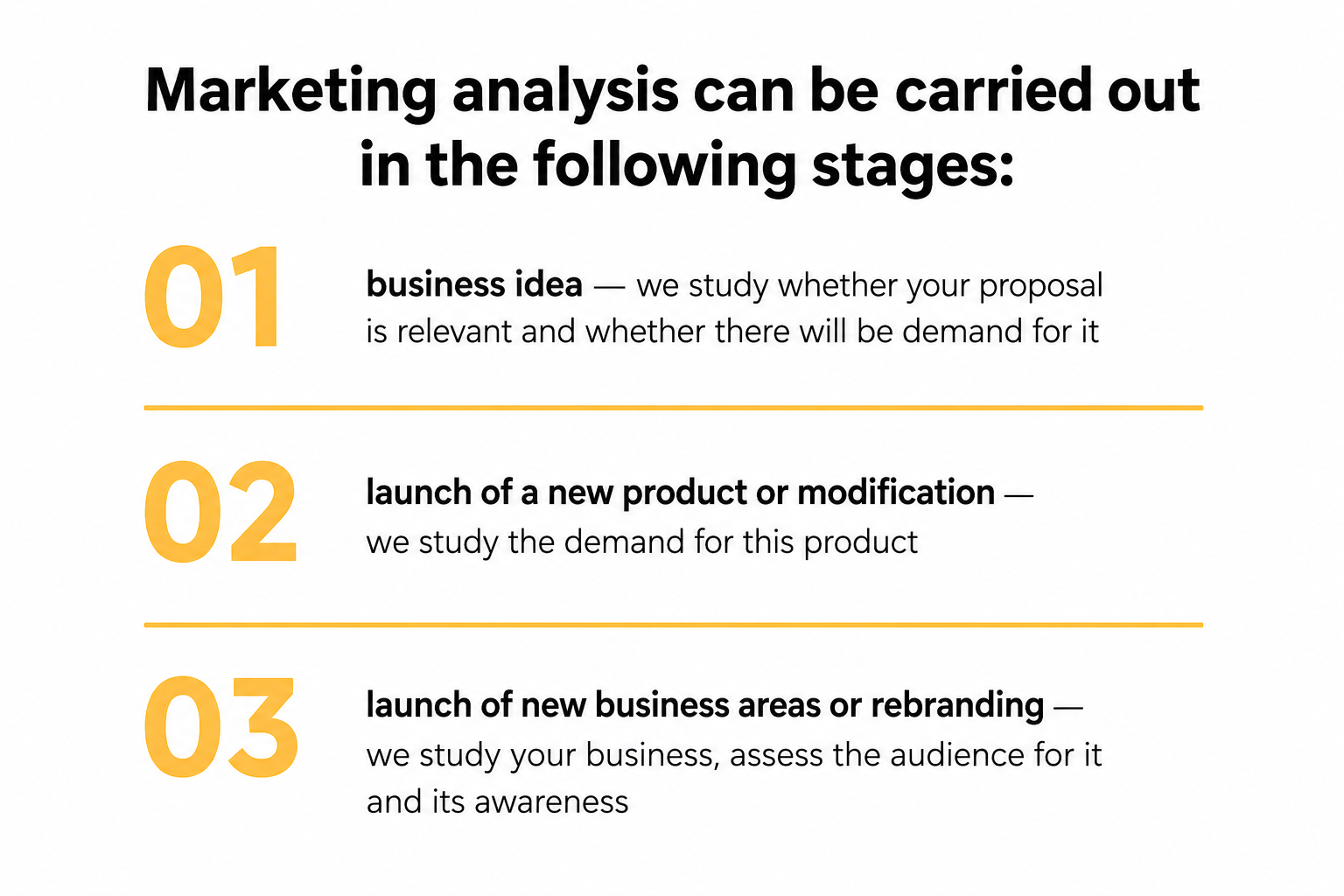
Another reason for conducting the research could be a new business venture, namely:
- entry into a new market;
- launch of a new product;
- rebranding;
- new product promotion channels, etc.
There is one word that unites all areas of business within the field of market research: consistency. After all, the market is constantly changing, with new competitors and products emerging all the time. That is why a one-off study will never be enough! Of course, it will yield some results, but these will be temporary, andfor effective business development, it is essential to respond constantly and promptly to changing trends and customer needs.
Research findings. How to use the information obtained
The final stage of the research involves drawing conclusions and making recommendations based on the information gathered.
As we noted above, drawing conclusions in quantitative research is far easier. It involves compiling statistics, which are then used to inform decision-making.
Qualitative research is more complex. The conclusions drawn from it, which will be used in the work, should be formulated by an experienced marketer.
They are often compiled into a single document containing sections relevant to the research questions. The document should include the research objectives, hypotheses, findings, limitations and recommendations. The findings are then used to update an existing strategy or develop a new one. Furthermore, they assist in the creation of new products and the entry into new markets.
The study will therefore serve as an effective tool for the marketing department.
What kind of research should businesses carry out?
Given such a large body of research, a logical question arises: “But should businesses always carry out all this research?”
Of course, you should choose research that suits your specific goals at any given time, but we can recommend some essential research for businesses.
Market analysis
It is absolutely essential to carry out this research before your product is launched on the market.
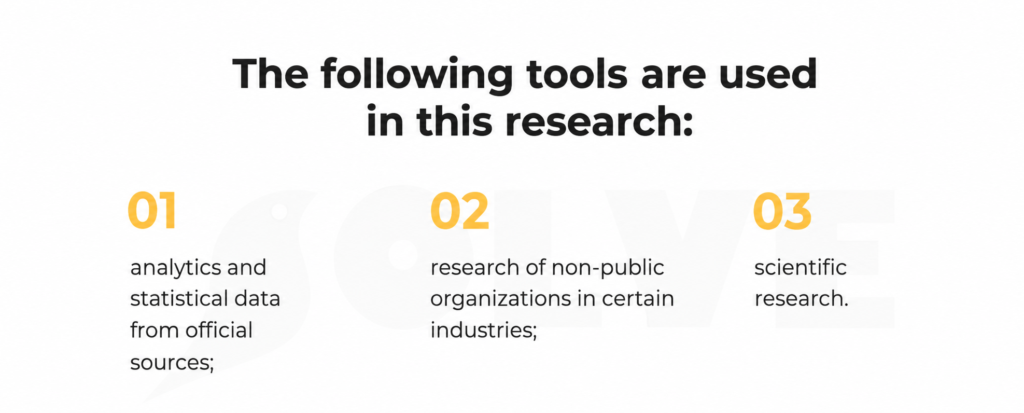
It is worth noting that, given the current situation in Ukraine, one should treat official statistics with caution, as data from the State Statistics Service may be distorted and may not reflect the true state of affairs.
Trend analysis
From time to time, analyse the popularity and demand for a particular product. This will help you decide whether or not to launch it. If it is a product you already offer, understanding the trends surrounding it will help you adjust your marketing strategy.
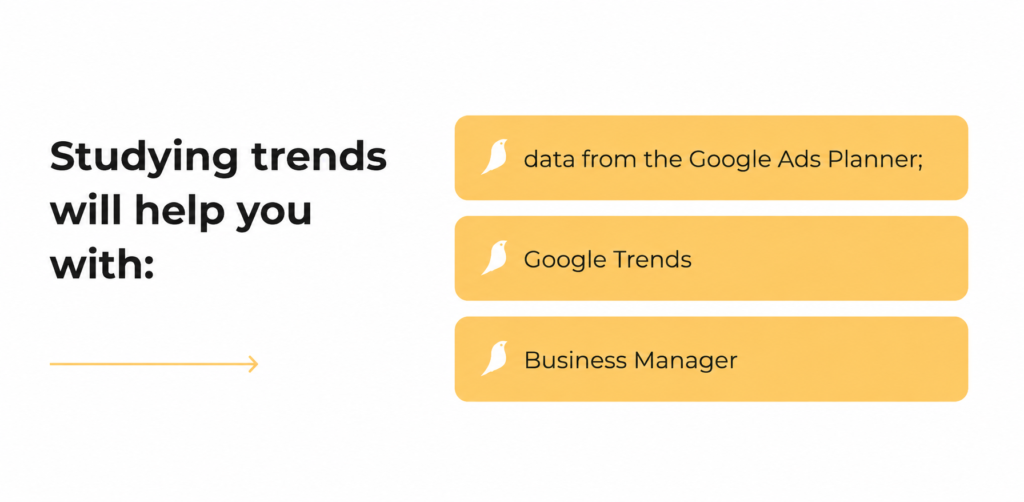
This study provides an insight into the market size, competitiveness and demand for the product.
Target audience research
Every business needs to understand its target audience in order to develop effective positioning, communication and advertising strategies.
Surveys, interviews and focus groups can help you research your target audience.
Among other things, interviews not only help you get to know your audience but can also attract leads. How did that happen? Read about it in our case study!
Quality research
Mystery shoppers and mystery customers can be used to assess quality.
A mystery shopper typically assesses the quality of service provided by the client and effectively replicates the entire process of purchasing a product or service. A mystery shopper also evaluates the client’s competitors. They assess the sales department but do not make any purchases.
This method allows you to assess your business. For example, you can evaluate the quality of communication, response times and the comprehensiveness of replies within your sales department. Mystery shoppers and customers can also be a useful way of researching your competitors.
Typically, a scenario is devised for such buyers or customers to simulate various situations and assess the quality of service provision under such conditions. Stressful situations are often simulated.
Competitor and price research
This test should be carried out fairly regularly, roughly once a month.
You should check the prices of your direct competitors’ products and compare them with your own, so that you can adjust your prices to reflect market conditions.
However, it is worth focusing not only on prices, but also on competitors in general: keeping track of changes in their strategy, positioning, customer numbers and prices.
That way, you’ll stay up to date with the latest developments and won’t miss out on any new competitors.
We usually carry out a comprehensive marketing analysis, which enables us to examine all or most of these aspects. The scope of Solve Marketing’s marketing analysis depends on the client’s objectives and requirements.