The marketing services market is more like a grand bazaar than a modern supermarket: a jumble of diverse offerings that differ in literally every way. So how do you choose what you need from among them?
To answer this question, we have written an article that examines the four most common specialisations of marketing agencies: performance agencies, creative agencies, SMM agencies, and outsourced marketing departments.
The idea to write this article came to me during a meeting with a client after the following dialogue:
Client: How do you differ from [name of the most well-known creative agency in Ukraine]?
Our team: But we do something completely different! — they replied and began to explain…
The first thing to start with: marketing agencies offer various services, but their range is not chaotic or random. The difference lies in the formats and specialisation of these services. Knowing the difference between them makes it much easier to understand what your business needs.
Episode 1. Marketing agency formats
Marketing agencies usually work in several typical formats of cooperation. Understanding these formats helps you choose the right partner and not expect the agency to do what it does not do.
The most common formats:
1. Project format
The agency performs a clearly defined task with a fixed deadline: website development, rebranding, marketing strategy, etc. After the project is completed, the collaboration may end or transition to a different format.
✔️ Suitable when you need to implement a one-off initiative or test a partner in action.
2. Outsourcing format or support
This is a long-term collaboration, where the agency is responsible for regular marketing activities: content, advertising, analytics, and communications support.
✔️ Suitable if you do not have a full-fledged internal marketing department or need specific expertise in working with specific tools.
3. Consulting
The agency does not perform tasks independently, but assists you or your team by conducting audits, developing strategies, advising on current issues, and training your specialists.
✔️ Suitable for companies with their own team that needs mentoring.
Episode 2. Marketing agency specialisations
The format of cooperation refers to the duration of the relationship and the involvement of the agency in ongoing cooperation. Specialisation, on the other hand, refers to what exactly it works on. Each agency has its own areas of expertise, and these determine its strengths and weaknesses. Here we will look at the four main specialisations of marketing agencies:
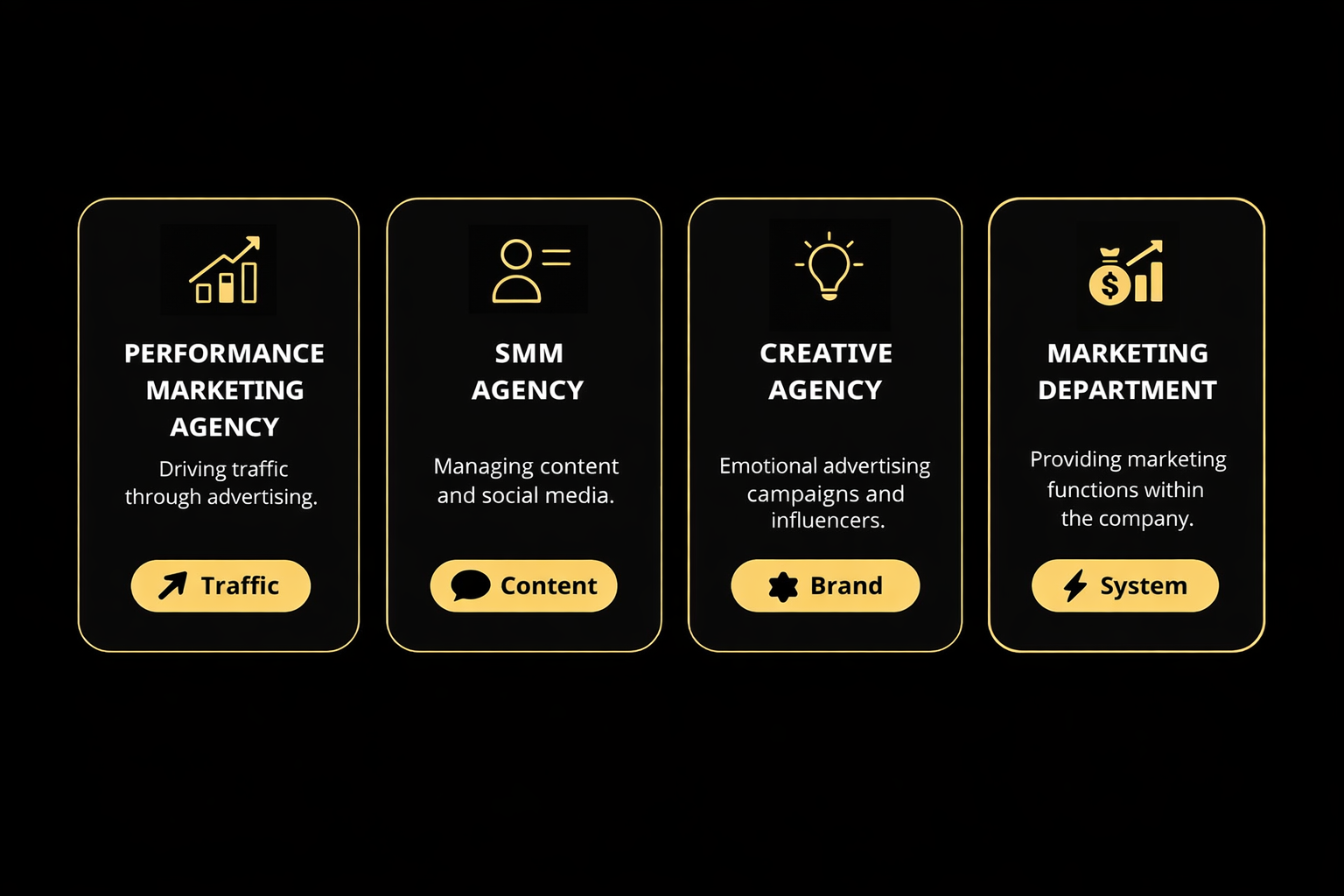
Performance agency: traffic here and now
Performance agencies are highly specialised companies that focus on specific advertising channels: SEO, PPC, targeted advertising, email marketing, etc. Their main goal is to generate conversions and traffic.
Traffic generation tools work great when you already have a powerful product, a well-developed sales platform, a profitable offer, customer trust, and other marketing aspects in place.
Issues that performance agencies are asked to address:
- Unable to obtain the planned number of leads.
- The actual cost of lead acquisition (CPL) needs to be reduced.
- The internal team lacks the expertise to professionally engage in SEO, PPC, and other performance marketing tools.
| + | − |
| Deep expertise in the lead generation tools the agency specializes in. | A dedicated marketer is not involved in the project. As a result, most performance agencies either do not develop a marketing strategy before launching campaigns or do it superficially. |
| Established automation processes for working with core tools, which increases execution speed. | A performance agency offers businesses only what is in its “menu.” In other words, if a company specializes in SEO and PPC, it will promote those services regardless of whether they are actually needed in a given case. |
| Expertise in web analytics and proprietary tools for tracking advertising performance. | Simply launching ads is often not enough to generate sales. |
💡 You need to come to a performance agency with a powerful product and well-established operational processes in your marketing department. That is, for example, if you have SaaS, someone has to think through customer acquisition funnels, trigger notifications, price offers, referral programmes, and many other things that make up the lion’s share of operational marketing for this type of business. If you have an internal marketing department, this is not a disadvantage at all. But if you only have a team of developers, performance tools will not be enough.
Cost of work:
Performance specialisation is the most common format for marketing agencies. That is why there is a significant difference in prices. For example, you can get professional SEO management for your local business from $500 to $3000 and above, depending on the specifics of your business, the region of promotion, the agency’s reputation, and the number and quality of projects in its portfolio. The cost of the agency’s services is supplemented by an advertising budget (for PPC and targeting) or a budget for link placement (for SEO services).
✅ Ideally, if:
You already have a marketer or an internal marketing department, you understand your product, audience, funnels, and positioning. Your sales platforms are well developed, and you are working on promoting your brand. All that’s left is to launch your advertising campaign to generate sales.
SMM agency: about content, presence and “let’s make it beautiful”
SMM agencies specialise in social media management: creating content, stories, graphics, posting, communicating with subscribers, and sometimes launching targeted advertising. They often work on visual style and tone of voice, shaping brand presence in the digital environment.
Issues that SMM agencies are approached about:
- It is not possible to reach the desired number of subscribers on your own, and content reach is low.
- Lack of self-discipline to regularly create and post content on social media.
- Maintaining social media accounts takes a lot of time, which is already lacking within the business.
| + | − |
| Visually appealing content. Teams in such agencies are typically built around a shared sense of style and awareness of trends. | Do not develop a comprehensive marketing strategy. |
| Often specialize in managing specific business niches. If you want your Instagram handled “just like that salon in their portfolio,” that’s exactly what you’ll get. | Like other single-channel agencies, they often operate without strategic integration with other marketing tools. |
| SMM agencies live and breathe social media, understand the nuances of promoting all content formats, and can make your reel go viral with millions of views. | Not always focused on business metrics (leads, sales). Clients often come to SMM agencies aiming for maximum reach, views, and followers. However, this does not suit all types of businesses, as a million views rarely translates into a “million dollars” in your account. |
Cost of work:
SMM agencies — This is the second most common type of agency. As with SEO, professional social media management can cost from $500 to $3,000 and above. The cost depends on many factors: who will be responsible for content development, how many company accounts there are, and how many social networks they need to be maintained on, the proportion of video content, budgets for attracting influencers, and much more.
✅ Ideally, if:
- You are a self-employed expert (e.g., tattoo artist, psychologist, massage therapist), and most of your clients come to you from Instagram. Therefore, all you need to do is continue managing your social media accounts to attract more clients. You can delegate this work to an SMM agency and focus on other things.
- If you already have a general strategic vision for business development, a marketer on staff, and a performance marketing agency involved in launching advertising, then an SMM agency simply complements the list of contractors who cover specific areas and tasks related to social media content for you.
Creative agency: when you need the wow effect
These agencies create emotional advertising campaigns, powerful brand videos, and collaborations with influencers and celebrities. They help brands become recognisable, make a statement and remind people about themselves through media pages, television screens and other channels of communication with a wide audience.
Issues that creative agencies are approached about:
- Low brand recognition.
- In the public consciousness, the brand is not perceived as desired. It is necessary to adjust the positioning for a wider audience.
- The loud advertising campaigns of other brands demand action; you cannot give them all your attention.
| + | − |
| Creates and executes bold creative ideas that help a brand gain national or even global recognition. | Results are difficult to measure in terms of leads or sales. |
| Experience working with multi-million budgets: attracting celebrities, buying media placements, and delivering large-scale campaigns for mass audiences. | Campaign outcomes are unpredictable: even large-scale efforts can go unnoticed or fail to resonate with the audience. |
| Able to create and deliver truly memorable campaigns — including award-winning work (e.g., Cannes Lions or Effie) that reaches millions. | Do not focus on operational marketing. Tasks such as building funnels, setting up platforms, preparing materials for clients and partners, launching ads, managing social media, referral programs, promotions, and offers — these form the foundation of day-to-day marketing but are typically outside their scope. |
Cost of work:
According to a survey by the All-Ukrainian Advertising Coalition, developing just the idea for an advertising campaign will cost the client between $20,000 and $45,000. That’s why agencies like this are the record holders when it comes to project costs. In addition to developing ideas and advertising campaigns at the national level, such agencies can offer to develop new positioning or corporate identity. Such projects can cost from $10,000 to $100,000. It is also important to add that the implementation of national advertising campaigns has a corresponding rider: the involvement of celebrities, the cost of filming, and the advertising budget can range from hundreds of thousands to several million dollars.
✅ Ideally, if:
You have a team of marketers working on marketing operations: strategy, social media management, and active advertising. Now you want to significantly increase brand awareness and reach the national level. You have the budget for this, and you won’t be disappointed if you don’t see significant sales growth after the advertising campaign.
An outsourced marketing department: development and support
This is a format of cooperation in which you receive a comprehensive marketing department without the need to hire people. Such a team develops a marketing strategy and ensures the daily operation of the marketing function. The marketing function is described in detail in this article.
Usually, cooperation begins with the development of a marketing strategy. The workflow is built around a specific business, so the list of marketing tools is determined during the strategy development process. This format is most similar to creating an internal marketing department, where the team and development vector are formed based on the needs of a specific project, rather than the agency’s existing “menu” of services.
Issues addressed to the outsourced marketing department:
- The company does not have a marketing specialist, so marketing processes are chaotic.
- There is no marketing development plan, and there is a lack of consistency.
- Tired of building the internal department, the marketing manager has resigned, and it is difficult to find a new one.
- Tired of managing different contractors, each of whom works in their own way without considering the overall goal of the company.
| + | − |
| Works with the project holistically: positioning, pricing, website, presentation materials, social media, advertising tools, and analytics. | In most cases, a marketing department does not meet the needs of microbusinesses or self-employed professionals. |
| Fully takes over the company’s marketing function on a turnkey basis, assuming full responsibility for the entire direction. | Unlike performance agencies with predefined service packages, an outsourced marketing department first develops a strategy and then builds a tailored team configuration for the specific business. This results in a longer time to launch advertising campaigns compared to performance agencies. |
| The project is managed by a marketer, ensuring deep expertise in strategic marketing. The developed strategy accounts for the interconnection between all necessary tools and promotion channels. | Requires the owner’s involvement at the beginning of the collaboration. While a marketing department enables delegation, effective delegation does not happen automatically. If you expect to simply pay and stay uninvolved, it will not work. |
Cost of work:
Depending on the experience of the agency working as an outsourced marketing department, the cost of developing a marketing strategy may vary from $3,000 to $20,000 and above. The cost of monthly maintenance depends on the scope of services and other business parameters. In terms of average cheques, marketing departments work with budgets ranging from $2,000 to $15,000 per month.
✅ Ideally, if:
- When launching a start-up, it is important to plan everything carefully so that you don’t have to learn the hard way at the expense of your advertising budget. Developing a marketing strategy for a start-up will help you save time and money, which are better invested in development.
- You do not have an internal marketing team, or it is already overloaded with other products and areas.
- You have long-term plans to become a leader in your market. Therefore, your marketing plans include working with the product, positioning, pricing, developing and improving your corporate website, SaaS or application, creating expert content, strategic tasks for developing your brand, and much more. You do not expect that simply launching an ad campaign will be enough to achieve significant results.
Agency format comparison table
We have only discussed the most common specialisations of marketing agencies. So, let’s summarise everything we have discussed above:
| Criterion | Performance agency | Creative agency | SMM agency | Outsourced marketing department |
| Objective | Leads, traffic | Brand, attention | Communication / sales on social media | System, business development |
| What they do | SEO, PPC, email marketing, targeting | Creative campaigns, videos | Content, posting, stories, targeting | Strategy, advertising, content |
| An internal team is required | Yes | Yes | Not necessarily | No |
| Format of cooperation | Project or contract | Project | Monthly maintenance or projects | Part of your company |
| Ideally, when | There is a strategy, traffic is needed | There is a brand, but still need some noise | Business lives on social media | A turnkey team is required |
How to make the right choice?
Now that we have covered the main formats and specialisations, it will be easier for you to determine which agency specialisation is closest to the realities of your business:
- Got a strategy, need to make it happen? → Pick a performance agency.
- Got a brand, need a high-profile campaign? → You need a creative agency.
- Is your business active on Instagram? → You need an SMM agency.
- Do you need to start from scratch, or is it time to move on to systematic development? → You need an outsourced marketing department.
Conclusion
Solve Marketing is an outsourced marketing department, where we help companies build their marketing function every day, which always involves long-term cooperation and partnerships lasting for years.
If, after reading the article, you realise that you need a different specialisation, we will be happy to recommend trusted partners in each of these categories. And if you say, “We need an outsourced marketing department,” then the article has helped you make an informed choice. And your informed choice is the main goal of this article.
A selection of marketing strategy development cases:
- Marketing strategy for accounting and tax accounting in the United States.
- Marketing strategy for a nutricosmetics brand.
- Marketing strategy for a real estate agency in Spain.
- Comprehensive strategy for entering the Australian market.
- Marketing strategy for peanut butter production.
A selection of case studies from the outsourced marketing department:
- Marketing department for CRM integrator.
- Marketing department for IPTel.
- Marketing department for a SaaS project.
🎯 Ready to meet and discuss your business?
We look forward to your enquiries!