If you’re an entrepreneur or planning to start a business, this article will save you a small fortune. And, more importantly, it will save you time.
This article will be particularly useful for those planning to launch an advertising campaign or looking for new contractors because the previous ones didn’t deliver. Stop and read this first. Because…
Advertising, managing social media, creating Reels — none of these activities on their own will deliver significant results.
Yes, it’s a counterintuitive idea, as most people associate marketing with these activities, since they form the public face of well-known companies. But have you ever wondered what goes on behind the scenes within their businesses?
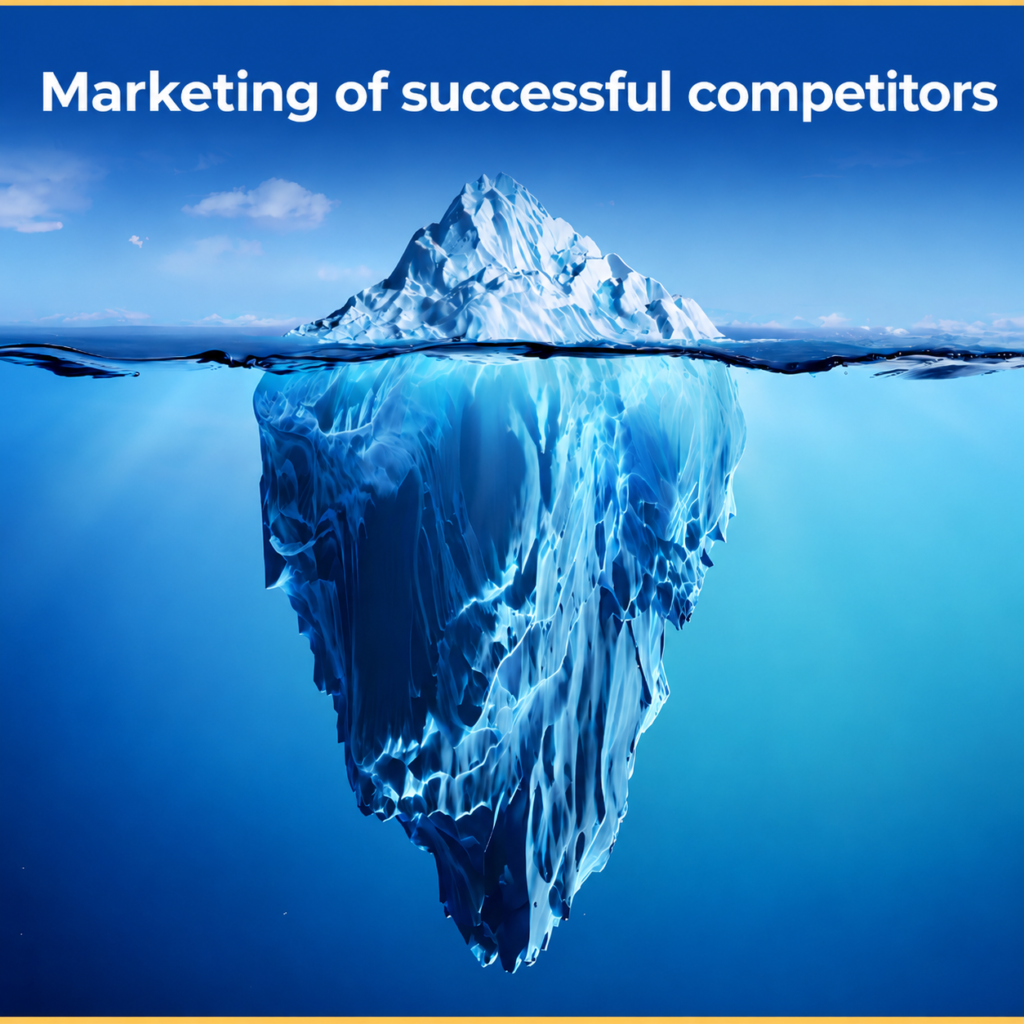
In this article, I will reveal the secret and explain how marketing actually works for market leaders and companies that are rapidly moving in that direction. The experience that formed the basis for this article.
It is important to note that marketing is just one of the functions of a business. And even if it performs flawlessly, a single function cannot carry the whole business on its own.
Right then, let’s get going:
1. You shouldn’t expect transformative results from operational tasks. It is strategic tasks that yield significant results
What are operational objectives, and how do they differ from strategic ones? There are various definitions, but I like this one:
An operational task supports an existing process, but does not improve it or lead to the creation of new processes or tools.
For example, for most businesses, a typical operational task is order processing. It is impossible to eliminate operational tasks entirely, but it is possible to optimise the time taken to complete them and automate those tasks that can be carried out without human intervention.
In other words, everything you do to keep the business running, just as you did yesterday, — is an operational task.
Conversely, strategic objectives are aimed at improving existing processes and creating new tools and processes. For example, developing new products, establishing new, non-traditional customer acquisition channels, creating a new loyalty scheme, building a community, and even designing a new website are all examples of strategic objectives in marketing.
Business only grows when new processes and tools are created.
That is precisely why advertising, managing social media, creating Reels and other similar tasks will not yield significant results. Once you get these processes up and running, carrying them out will cease to be a strategic task for you and become an operational one. What’s more, your competitors are already carrying out these operational tasks. Some of them have been doing this for so long and so well that it will take you a long time to catch up with them.
This doesn’t mean you shouldn’t, for example, run adverts. Operational tasks need to be carried out as well. But you shouldn’t expect transformational results from operational tasks.
So why doesn’t everyone focus solely on strategic tasks? The answer is simple:
2. Achieving strategic objectives in the short term has no impact on profits; it merely increases expenditure
A real-life example:
Peter and Ivan work as managers in a department that does not yet have a manager. Peter realises that the company is set to expand and that, sooner or later, he will be able to become a manager. Especially if he works hard, improves his English and takes further training courses.
Every day, Petro works hard at his job, and in the evenings he attends further training courses. At the weekend, Petro doesn’t get a chance to rest either, as he has to go to English lessons and do his homework. Petro works, studies and gets much more tired than he used to. And he has even less money left, as he still has to pay for the courses.
Apart from Peter, Ivan also works in the department. Ivan thinks he’s doing enough as it is. He sees the effort Peter is putting in and makes fun of him, because no one has promised Peter anything; he does everything on his own initiative and without any guarantees.
So, after work, Ivan goes to a bar with his friends to unwind.
Two long years pass before Petro gets a promotion.
Behind their backs, Ivan tells his colleagues enviously that Petro was just lucky. That Petro simply has connections in senior management. That Petro simply bought his new position. And so on…
Applying this metaphor to the business world, we realise that we are faced every day with operational tasks that are essential for keeping the business afloat. But if we focus solely on these operational tasks, we will never ‘get promoted’ in the eyes of our customers and will be unable to take the business to the next level.
Over the past 16 years, I have met more than 2,000 business owners. And, according to my statistics, fortunately, no more than 10% of entrepreneurs can be like Peter. I say ‘fortunately’ because, under such circumstances, it is possible to become a leader even in the most competitive market.
All you need to realise is this:
3. The continuous pursuit of strategic objectives — is the only thing that delivers tangible results for a business
Let’s imagine that a business is like a ball rolling round the rim of a funnel. I like this metaphor because, just like that ball, a business needs to carry out its day-to-day operations to stay in the game.

Business growth is like a ball rolling up a funnel. Just like the ball, to overcome the forces of gravity, a business needs to make an effort to ‘get higher’. That is, to earn more whilst enjoying greater stability. Conversely, it is enough simply to stop doing something to ‘fall into the abyss’, that is, to bring the business to a halt.
Of course, if your business is part of a group of companies or has been established with external investment, it has greater capacity.

If you’ve already started a business, you’ll know how much effort it takes just to stay where you are.
These efforts are required by the operational tasks necessary for the production of a product or service.
Why bother moving up at all?
Where the funnel widens, you no longer need to work so hard just to avoid falling down. The customers there are of a higher calibre, and the business is much more stable and sustainable.

A business thrives when it creates new, efficient processes and tools.
Conversely, if you keep doing the same thing, sooner or later the market will change, new products and marketing methods will emerge, a powerful competitor will appear, or you will simply run out of steam.
And the business will cease to exist.
To climb the ranks and ultimately become the market leader, it is not enough simply to do your job. You need to go the extra mile in every area of the business, the key ones being product development, HR, marketing and sales.
But are there any specific actions that have the greatest impact on this upward trend? It is extremely difficult to gauge the impact of any single action on the results achieved.
I attribute this to «effect marginal gains», When viewed in isolation, this influence is imperceptible, and it may even seem as though nothing is happening. Therefore, the possibility of achieving success in a ‘bright future’ depends both on our psychological ability to overcome the ‘valley of death’ until our actions begin to bear fruit, and on having the resources to see us through this period.
The main thing is to dispel the illusion that goes something like this:
«If I just do my job well, my business will grow. Do well and all will be well.»
No, it won’t.
If, over the course of the week, you haven’t done anything to create or improve an existing process, or developed a single new tool, then this week has been a waste in terms of business development.
Therefore, to ensure we don’t lose sight of our strategic objectives, we need to keep them constantly in mind. By analogy with IT, in our marketing department we call this the strategic task backlog.
How can you tell which tasks should go into the strategic backlog?
The key principle behind drawing up a list of strategic objectives is to focus on creating new processes and tools, and on improving existing ones. Typical examples of strategic objectives include:
- Product range development.
- New content formats and distribution methods.
- New sources of enquiries.
- Website development and ongoing refinement.
One way to build a blog is to focus on what really matters to your customers. The framework developed by Solve Marketing can help you with this selection criteria.
But who should be responsible for this? Whose remit is it?
This is precisely what the following point is about:
4. For strategic business objectives to be achieved effectively, the marketing function must be in place
The main thing is that your marketer understands that marketing is more than just advertising and social media posts. For example, Solve Marketing’s Marketing Department constantly develops and updates its own list of strategic objectives that need to be achieved.
The main thing is that your marketer understands that marketing is more than just advertising and social media posts. For example, Solve Marketing’s marketing department is constantly drawing up and updating its own list of strategic objectives that need to be achieved.
За кожну функцію має відповідати конкретна людина. Відповідно за функцію маркетингу відповідає маркетолог. Маркетолог — це диригент оркестру маркетингу, маркетолога не можна замінити smm-спеціалістом чи таргетологом. Про функціональну різницю між цими спеціалістами ми розповіли тут (розділ 3).
Не важливо, чи маркетолог працює в штаті компанії, чи на аутсорсі.
Головне, щоб ваш маркетолог розумів, що маркетинг — це більше, ніж реклама та дописи в соціальних мережах. Наприклад, відділ маркетингу Solve Marketing постійно формує та доповнює власний перелік стратегічних задач, які потрібно виконати.
Here are the main areas for which the marketing function is responsible:
- Creating a product that people need. It is a myth that marketing can sell anything to anyone. Yes, the first time around, people buy what promises to meet their needs. But they only continue to buy what they actually need.
- Market research and strategic planning: A clear understanding of who makes purchasing decisions in this market and among which groups. What needs drive customers’ choices, and what factors influence those choices. Pricing, market segmentation.
- Formulation of the proposal: A well-thought-out product range: entry-level, standard, premium and VIP segments. Development of positioning and value propositions that set the offering apart from the competition. Analysis and comparison with competitors’ offerings.
- Simplifying the user experience and creating a wow factor: covers activities that directly influence the development of the product. For SaaS products, this refers to the functionality itself and how it is used.
- Promotional platforms: anything that answers the question ‘where should communication take place?’. Creating, designing and developing platforms: websites, blogs, social media accounts for the company and its founders, quizzes, communities, themed forums, conferences, etc.
- Content and its dissemination across communication channels: Social media posts, Reels and other short-form content, PR articles, features, interviews and podcasts, live streams, regular YouTube series, corporate and personal blogs and vlogs. Creating a ‘content factory’ where a single piece of content is repurposed across various formats and platforms.
- Building and developing lead generation channels and “nurturing”: organic and paid search (SEO and PPC), targeting, promotion of advertising posts, affiliate networks, conferences, sourcing and compiling contact databases for the sales department, email and messenger marketing, Telegram channels, and developing unique promotional strategies tailored to the specific nature of the business.
- Developing tools for the sales department: templates for presentations, commercial proposals, visualisations and other materials.
- Collection and analysis of customer feedback: organising cast events, gathering feedback, and sharing feedback on internal and external platforms. Compiling and disseminating case studies.
- Analytics and automated reporting: Developing analytics systems to track the effectiveness of lead generation and key performance indicators: traffic from all sources, marketing department expenditure, number of leads, and revenue generated. Monitoring the implementation of new processes and tools within the marketing function.
That is precisely why you shouldn’t expect advertising, social media management and creating Reels alone to do all the work in place of a marketing department:
- Social media —This is just one of the channels of communication.
- Launching an advert — only part of the implementation of the communication strategy.
- Creation reels — just one of the formats of content used in marketing communications.
And so we’ve come full circle back to the beginning of this article.
5. What should I do now, and how should I go about living with this information?
After reading this article, every reader’s reaction may vary.
What are your thoughts on this?
Perhaps you’ve felt inspired by realising what needs to be done, how to do it, and what to look out for? Or are you feeling disheartened because marketing isn’t as simple as it seemed?
Or perhaps you disagree entirely, since your business has managed just fine without a marketing function up until now?
Of course, in the early stages, a business can grow even with only basic sales, HR and marketing functions in place.
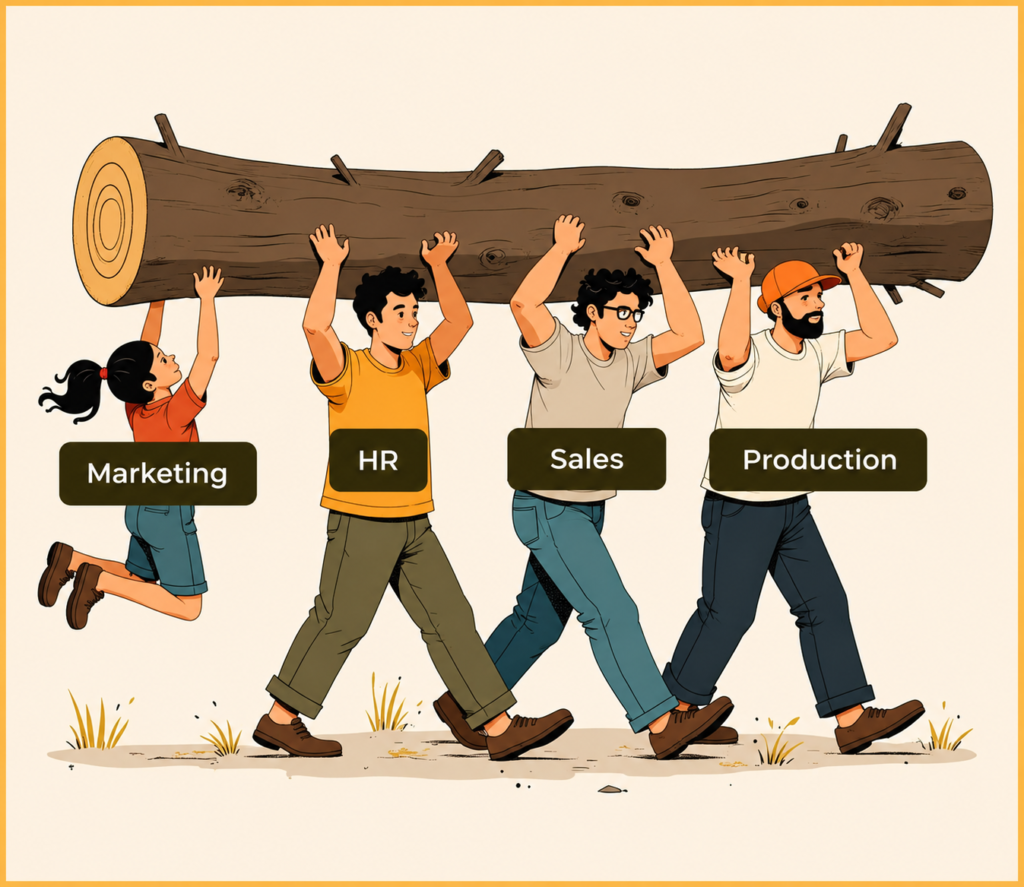
Если же ваша компания развивалась и без мощного отдела маркетинга, скорее всего, это означает, что роль движущей силы взяли на себя другие подразделения.
Но если вы уже некоторое время находитесь на месте, вспомните о маркетинге.
Создать маркетинговую функцию не так сложно, как кажется. Цель, сформулированная в цифрах, наличие маркетолога, стратегия и план действий — все это станет отличным началом.
If you have any further questions, you can always:
- Get a free consultation on setting up a marketing function.
- Discuss mentoring on setting up a marketing department.
- Book an audit of your marketing department’s performance.
- Get help with filling in the strategic objectives section.
- Engage a remote marketing team and receive turnkey marketing services.
When the marketing department is working as it should, the team delivers on strategic objectives and brings you benefits every day.