“Cutting back on advertising to save money is like stopping the clock to save time” — the significance of advertising summed up in a single sentence. These are the words of Andrew Mackenzie, Chairman of the Board of the multinational oil and gas company Shell plc, so there is no doubt as to their truth.
But that’s all well and good when you have budgets like Shell plc’s and your headquarters are in London. But what are Ukrainian owners of small and medium-sized businesses, whose marketing budgets are limited, supposed to do?
So, you shouldn’t give up on advertising, but you need to consider beforehand where and how best to promote your product. It makes sense to start with Google and Facebook. Which platform will prove more effective in your case? Let’s take a closer look.
Google or Facebook? Facebook or Google?
There is no single answer, nor can there be one. This is because these channels use different marketing tools to address business challenges.
Google is a search engine designed to provide answers to users’ queries. You get exactly what you’re looking for.
Facebook is a social network. Advertising on the platform isn’t the result of users’ searches, but rather recommendations based on their interests. It’s like a subtle hint that appears in the news feed.
In terms of cost and return on investment, Facebook advertising is cheaper than Google advertising. However, conversion rates are lower, so revenue from such advertising will be lower than from Google’s contextual advertising in many niches.
What can you expect from Facebook advertising?
This is a great tool for presenting a new brand to its target audience. It can be used to make the brand more recognisable and to generate interest among potential customers.
It makes sense to approach Facebook with a new product when it is first launched on the market. Users are not yet aware of it, so they won’t be searching for this product or service on Google. Advertising on Facebook will subtly introduce the new product and gently spark interest.
What’s more, adverts aimed at impulse buying work really well on Facebook. These might include children’s products, tasty treats, jewellery and so on. In other words, the user didn’t even realise they wanted to buy it, but when they saw it, they wanted it so badly they couldn’t resist.
It is worth noting that Facebook is an excellent choice when you’re promoting not a product or service, but the idea of building a community around a particular business.
When it comes to targeting Facebook, it’s worth noting that the social network itself won’t find your ideal customer. It will simply help you identify your target audience, but you’ll need to create a detailed customer profile and set up your adverts yourself. Targeted advertising on Facebook works best:
- within and at the end of the sales funnel;
- only with a clearly defined audience;
- through remarketing (for example, targeting users who visited the company’s main website but did not make a purchase); see the example below.

And of course, it is precisely through social media that one can gain a comprehensive understanding of the target audience, their interests, concerns and behavioural patterns. During his appearance before the US Congress, Mark Zuckerberg confirmed that the social network’s algorithms collect data on a vast number of users, including those without a Facebook account, thereby enabling effective engagement with target audiences.
In other words, even users who haven’t indicated in their profile that they have children will see these adverts aimed at parents:

The return on investment for Facebook advertising is measured not only in financial terms but also in terms of brand reputation. Having a loyal community and its trust in the brand represents enormous potential for business growth.
However, at a certain stage, this advantage turned into a serious disadvantage for Facebook and the entire Meta corporation. This happened when owners of the new iPhones gained the ability to block social media platforms and websites attempting to track user data. When over 80% of users enabled the blocking feature, the “value” of a buyer on Facebook — which relied heavily on cookies for ad targeting — rose from $6 to $100+.
This decision has not affected Google advertising, as the search engine focuses not on users’ activities but on the queries they enter into the search bar. Advertisers should bear this in mind.
What can you expect from Google Ads?
Google performs well at the early stages of the sales funnel. So if your primary goal is to convert potential customers into actual customers, this tool will certainly come in handy.
On Google, unlike Facebook, you’re dealing with a highly engaged audience who know what they want and are using specific search queries to find a suitable offer. That’s precisely why you achieve higher conversion rates.
However, Google advertising won’t be particularly effective if you’re promoting a new product. If, on the other hand, you’re offering a product or service that’s already familiar to your audience, a marketing campaign will enable you to significantly expand your customer base and boost sales.
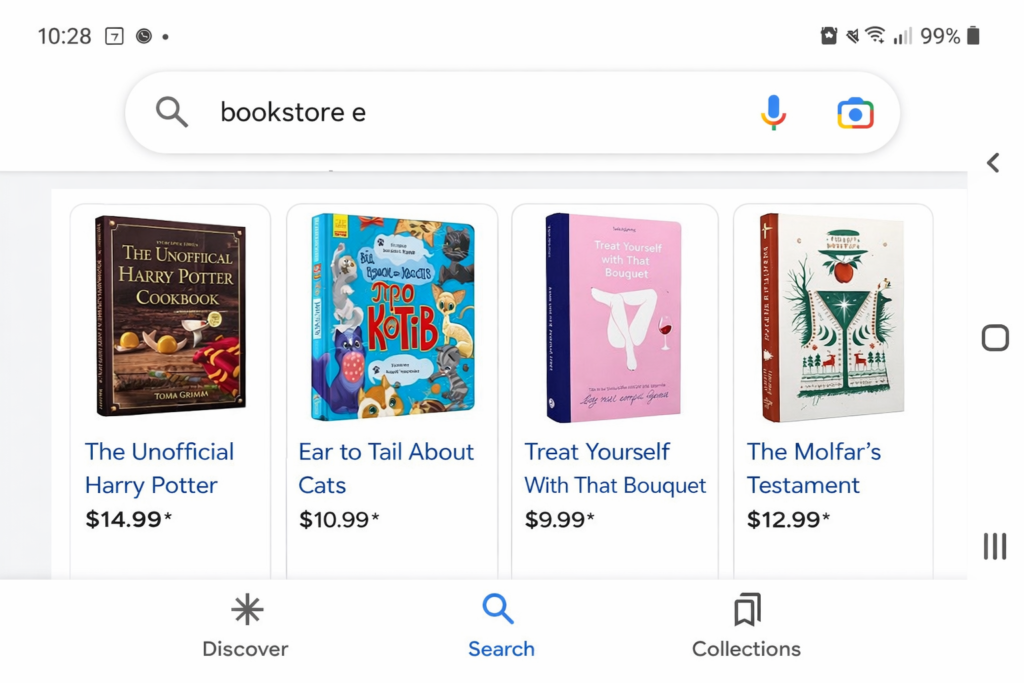
With Google, which focuses on user queries, you don’t need to know exactly who your audience is in order to show them your adverts. However, Google also offers targeted targeting based on location. In this case, the advertiser excludes all users located outside a specific city or region.
The effectiveness of advertising here is influenced not only by the cost of the ad placement but also by the content and quality of the advert or website. Companies that take a responsible approach to the content of their websites and adverts, and are willing to invest in this, can secure better positions in search results, even if they pay a lower bid for their adverts.
So, which is better — Google or Facebook?
The correct answer is both Google and Facebook. By making effective use of the strengths of both platforms, you can achieve excellent results in sales and advertising. First, you’ll introduce yourself and learn everything you can about your customers using Facebook’s features, and then you’ll reach out to them with a specific offer via Google.
In both cases, to avoid wasting your advertising budget, it is important to first develop a customer profile:
- age;
- become;
- marital status;
- area of interest;
- profession;
- fears and needs.
Please also answer the following questions:
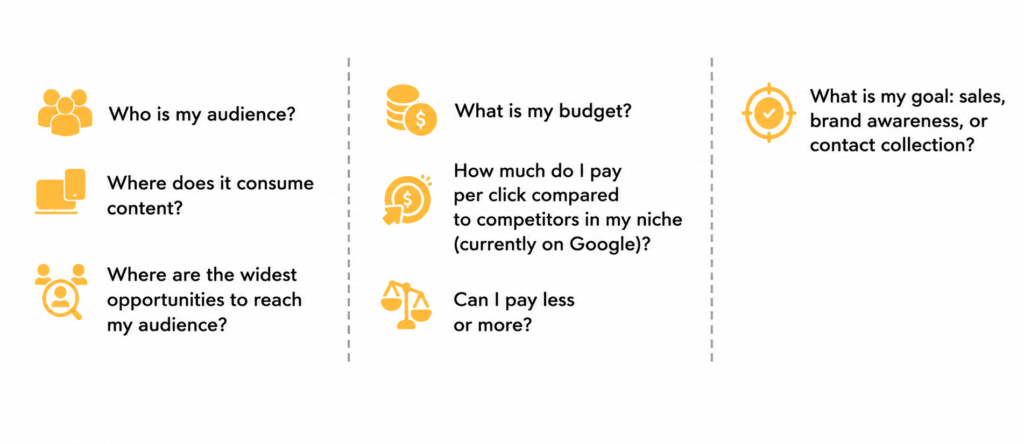
This will help you choose the right marketing channels and target your audience effectively.
It’s also worth considering the type of product or service. If your potential customer’s door lock gets stuck, they’re more likely to search for it on Google than to look for the service they need on Facebook.
If you’re working solely within your budget and based on the price of your product, then with a small budget and an affordable offer, it’s best to start with Facebook. The same applies if you simply want to test out advertising. On Facebook, you can start with as little as $5 a day, compared to a minimum of $0.50 per click on Google.
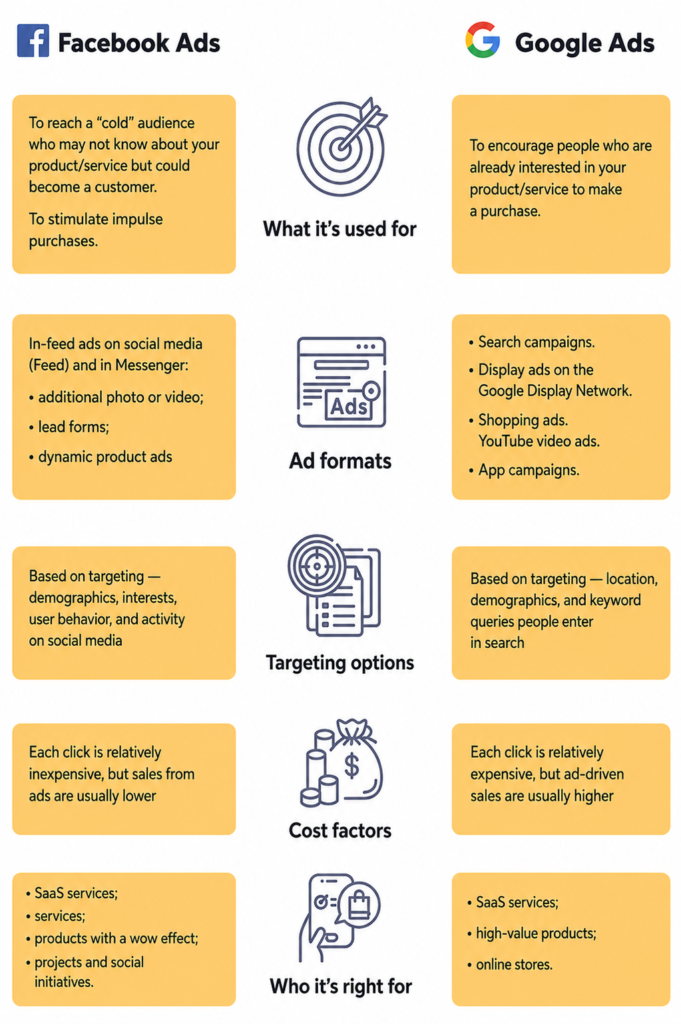
For your convenience, we have created the following comparison table:
What do you need to launch an advertising campaign?
On Facebook, start by creating, populating and bringing your business page to life:
- review the information you provide to users;
- draw up a content plan and prepare posts about the company and the product;
- Strengthen your connection with users through comments, chatbots and replies to private messages.
From a technical point of view, the most important thing is to set up a Pixel, an analytics tool that will help you measure the effectiveness of your adverts and analyse user behaviour on your website. Technically, a pixel is similar to Google Analytics.
It tracks when someone visits the website and performs specific actions (makes a purchase, views contact details, submits an enquiry or adds items to their basket). All this data can be used to set up Facebook retargeting and optimise ad delivery.
Retargeting refers to advertising campaigns where the target audience consists of people who have already shown some interest in a product or service. Retargeting ads can appear on social media, on Google AdWords partner sites, and so on.
The next step is to create an audience using a tool such as Look-a-Like (similar audiences). This is generated based on the characteristics of users who interact with your page, ad or website.
As you can see, setting up Facebook ads requires a fair bit of extra work. With Google, things are a bit simpler. You can launch an ad in just a few minutes. But such a quick setup isn’t always effective enough. So, to start with, you’ll still need:
- prepare the website — populate it with relevant content, make it user-friendly, etc.;
- estimate demand and ensure that the product is always in stock;
- set up a sales department and organise the delivery process.
Your task is to do everything you can not only to secure the order from the client, but also to fulfil it to a high standard.