In the 2023 financial year, the low-cost airline Ryanair achieved a record net profit of:
$2,09B
An amazing result?
And if we compare it, for example, with Qatar Airways Group, a premium airline, which generated the following revenue over the same period:
$1,7B
This example shows that you don’t necessarily have to be a premium brand — it’s enough to know your audience well.
How does search engine optimisation work?
The whole essence of positioning can be summed up in these two paragraphs:
1. To ensure that customers choose you, you need to: quickly convey your key differentiator to them. This differentiator must be a key factor in their decision.
Taking airlines as an example, we can see that there is no single deciding factor that applies to all customers at the same time.
2. To find your niche, you need to abandon the idea that your customers are “anyone who might be interested in what you have to offer”.
Only by narrowing your focus and consciously choosing to leave out part of your audience will you be able to connect more closely with your target group. This is precisely what will help you stand out from those who continue to try to be useful to everyone at once.
The evolution of positioning
The more players there are in the market, the more pronounced the division between them becomes. However, this division does not happen overnight, but rather as a result of strategies aimed at capturing a specific niche and securing a place in customers’ minds.
For example, until the 1970s, the air travel market was predominantly a premium sector — with expensive tickets, a high standard of service and a focus on business travelers and affluent passengers.
However, the Airline Deregulation Act, passed in 1978, allowed airlines to set their own prices and routes. This paved the way for the emergence of the low-cost model. The new approach involved:
- a minimum of services;
- the use of secondary airports;
- high aircraft speeds;
- payment for the seat only.
This has made air travel accessible to the general public. In response, major flagship airlines such as Lufthansa, Emirates, and Singapore Airlines have begun to position themselves even more clearly as premium carriers — with VIP lounges, luxury service, and a focus on prestige, comfort, and safety.
The market was thus divided into:
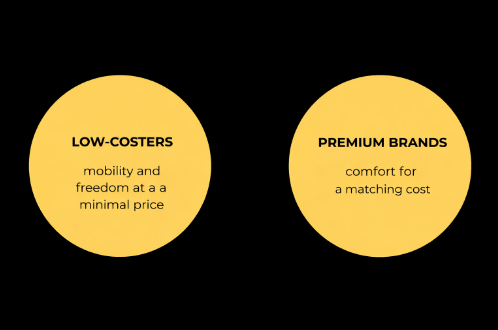
Each segment has developed its own marketing model tailored to a specific customer.
Air transport is a classic example of effective niche marketing and differentiation in a highly competitive environment.
When is positioning required?
Any effective positioning is characterised by the fact that it is simple and easy for customers to understand. Most examples of positioning are based on this formula:
[Business name] is a [type of business] that stands out because…
Without a clear positioning, customers cannot quickly grasp the benefits of your offer, and therefore find it difficult to make a purchasing decision. Also:
✅ Customers don’t understand what sets you apart.
✅ The team has different ways of explaining what you do.
✅ Багато лідів, але не ті, з ким хочеться працювати.
✅ Lots of leads, but not the kind you want to work with.
✅ People are confusing you with your competitors.
Depending on the stage of the company’s development, the objectives and positioning requirements may vary:
| Startup | Established Business | |
| Goal | Explain what makes the product new | Strengthen understanding of your competitive advantages |
| Why It Matters | Customers don’t know why they should choose a new product | Helps you stay focused and stand out |
| Focus | Clearly define what makes your product different and innovative | Get closer to your ideal customers |
| Risk Without Positioning | Low brand awareness and customer confusion | A vague brand and weak communication |
| Example Positioning Statement | “We replace traditional X with faster Y.” | “We are the choice for companies that value stability in X.” |
A proactive and adaptive approach to search engine optimisation
Let’s return to the example of air travel. As soon as restrictions on ticket pricing were lifted, some companies immediately began to dominate the low-cost segment. In any new market, or a market where regulatory restrictions are being lifted, a company can either rapidly carve out its own niche or continue to operate “for everyone” for a while longer and observe the process of niche formation.
1. A proactive approach to positioning
(When the market is still taking shape)
You can choose the audience segment that suits you best and focus on it. When other companies eventually realise that you have established a stronger foothold in a particular market segment, they will either try to compete with you for that segment or look for another available one.
→ To do this, you will need:
- Have the courage to start niche marketing in a market where the “one-size-fits-all” approach still prevails.
- To give up one part of the market in order to get closer to another.
→ In business literature, this is known as:
- Blue Ocean Strategy;
- White Space Strategy — a strategy for unoccupied space.
2. An adaptive approach to positioning
(The market is already divided among companies operating in their respective segments)
A new company entering the market needs to understand which segments are already occupied and which are still available. Depending on the answer to this question, it must then determine how to create a new segment, or at the very least, highlight what sets it apart.
→ To do this, you need:
- identify an untapped niche (a niche in terms of needs, values, experience, or approach);
- repackage a familiar offer in a new way;
- stand out from the competition in terms of details, values or format.
→ In business literature, this is referred to as:
- niche strategy / niche differentiation;
- the “Red Ocean Differentiation” strategy;
In a competitive market, it is positioning that forms the basis for achieving your goals. Not advertising. The competitive market is oversaturated with advertising. Advertising merely helps to draw attention to your brand and your offering. But it is positioning that influences the customer’s decision to take the next step and purchase your product.
Steps for developing a positioning strategy at Solve Marketing
Positioning is essential for building an effective communication strategy, but it doesn’t work on its own. And simply having it as a phrase on your website’s homepage won’t be enough.
The first thing we’re going to do now is establish a shared understanding of positioning and how to apply it. Here are seven principles you need to follow to ensure that positioning works for you:
7 principles of positioning
| reflects the essence of your business | meaning, not just a phrase | should be understood by everyone on the team |
| a long-term strategy | giving up part of the market | obvious internally, but new to the audience |
| based on customers’ decision-making factors | ||
Principle 1. Your positioning reflects the essence of your business.
If you disagree with it or are simply indifferent, it won’t work. That’s why it’s impossible to develop a positioning strategy without your direct involvement. It’s a joint effort.
Principle 2. Positioning is, first and foremost, a concept; it is a meaning, not just a specific phrase or formulation. If your client can explain in their own words who you are and what makes you better, then your positioning is spot on.
Principle 3. Everyone in the company must understand the positioning: from the CEO to the office manager. It is not necessary for everyone to memorise a phrase whose meaning they do not understand. It is enough to ask the team: “Who are we?”, “What do we do?”, “What makes us better?” And you will understand whether your positioning is working. If your positioning attracts an interested client, but the manager on your side starts saying something completely different, the positioning will not work.
Principle 4. Positioning is a long-term game. If the company’s direction changes every six months depending on the situation, if the focus shifts to attracting different customer segments, and if various products and services appear and disappear, positioning will not work. Be prepared to repeat the same thing for 2–3 years to see results.
Principle 5. Effective positioning always involves voluntarily giving up one segment of the market in order to get closer to another. For example, in the airline industry, it is impossible to be both a low-cost carrier and a premium brand at the same time. This is an example of strong positioning.
Principle 6. Effective positioning strikes everyone who has been in the business for a long time as self-evident. But not to customers. A common mistake is to expect marketers to come up with some fancy jargon or introduce new ideas that bear no relation to what you see every day.
Principle 7. Effective positioning is based on an understanding of the factors that influence your customers’ choices. The more significant the factor underlying your positioning, the stronger the customer’s incentive to choose you.
If our vision aligns, we’ll get to work on developing your positioning.
Stages of positioning development
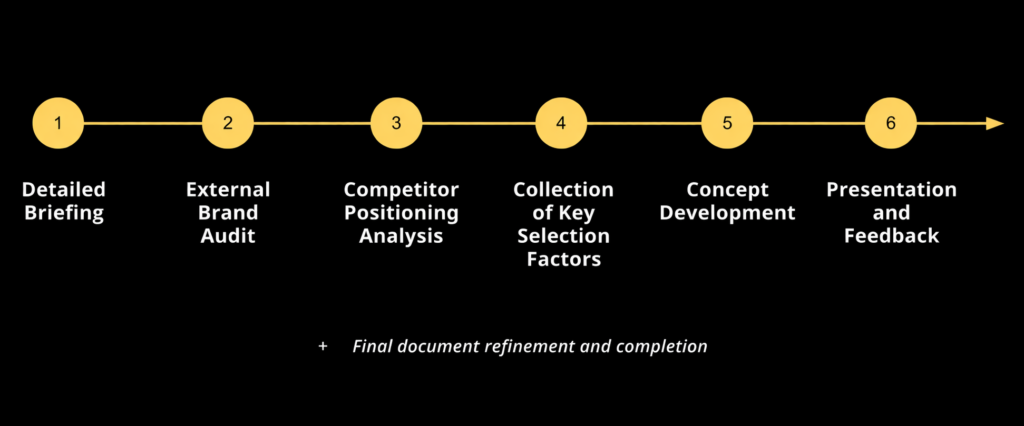
1. It all starts with a detailed briefing, during which we find out how you see your strengths and what sets you apart, what you consider your current positioning to be, and what direction you envisage for the company’s development. We discuss the profile of your ideal client, as well as the types of clients you would prefer not to work with.
2. Once all the initial data has been gathered, we move on to the external brand audit. We analyse the impression clients form after visiting your website and social media channels, viewing your promotional materials, and interacting with your team.
3. At the same time, we analyse our competitors’ positioning. This enables us to gain an overall understanding of the niche and identify strong players with well-established positioning. Or, conversely, to see that most players do not stand out.
4. To develop an effective positioning strategy, we need to identify the key selection factors, which we do in parallel with an analysis of our competitors’ positioning.
5. Once we have all the relevant information, we move on to developing 5–6 positioning concepts as we see them. We outline the descriptions, advantages, and disadvantages of each concept.
6. The next step is a joint meeting to present the concept and gather feedback. Usually, at this meeting, we either decide on the way forward or go back to the previous step and develop new concepts.
7. Once the concept has been agreed, we refine the wording options and how this positioning will be used in communications.
8. The final step is to draw up the final document containing guidelines, examples of use, and an implementation plan. If required, we can provide training for your team ourselves, explaining and demonstrating through examples how to use positioning when communicating with clients.
Positioning should not be a standalone document, isolated from the rest of the marketing strategy. On the contrary, it forms the foundation for other elements of the marketing strategy, such as the communications strategy, the lead generation strategy, and the development and refinement of advertising platforms.
Are you ready to make up your mind?
At Solve Marketing, we help you identify your true positioning and integrate it into every aspect of your communications. Get in touch, and we’ll help you develop and implement an effective positioning strategy that will serve you well for years to come.