Search engine optimisation has been one of the top tools for website promotion for years. It helps you get steady traffic from search results, attract new audiences, and boost sales of goods and services. But SEO has one big drawback — it’s hard to predict.
The fact is that the effectiveness of SEO promotion cannot be considered a clearly measurable indicator due to numerous factors that influence ranking. And if someone tries to prove the opposite and provides certain guarantees without even familiarising themselves with your project, in most cases, this is simply manipulation.
What is the difficulty in measuring the effectiveness of website promotion?
The main reason lies in a wide range of objective factors that neither the website owner nor promotion specialists can influence. Among these factors, the following are particularly influential:
- Changes in search engine algorithms. Google and other search engines regularly update their website ranking algorithms, which can affect rankings to varying degrees. In most cases, the details of such updates are either not disclosed at all or are only disclosed superficially. Accordingly, adapting to the updated requirements becomes significantly more difficult.
- Active competitive environment. The site’s position depends not only on the actions of the optimisation team, but also on the activity of competitors. The higher it is in the niche, the more difficult it is to reach the top and secure a position there.
- The influence of local factors and personalisation. Search results may vary for different users due to search personalisation and geotargeting. This means that your website may be in the top 3 for users from Kyiv, but may not even make it into the top 10 for users from Chernihiv.
- The inability to accurately track the impact of offline factors. These factors include brand reputation, external advertising campaigns, word of mouth, etc.
With a comprehensive approach to website promotion, there is another difficulty — the lack of a clear distinction between the impact of SEO and other marketing activities, such as content marketing, SMM promotion, and others. Therefore, it is very difficult to establish a clear relationship between specific SEO efforts and results. However, this does not mean that it is impossible to measure the effectiveness of search engine optimisation in principle.яти ефективність пошукової оптимізації в принципі неможливо.
Why you shouldn’t trust SEO optimisers’ “guarantees”
If you use the search query “SEO promotion with a guarantee” in Google, you will get dozens of offers such as “100% success guarantee”, “guaranteed protection against conversion decline”, “guaranteed long-term results”, etc. In reality, a contractor cannot give such guarantees. Considering the factors listed above, it is important to understand that the concepts of “SEO” and “guarantee” are fundamentally incompatible.
Moreover, you should not take the word of optimisers who give guarantees and make predictions before even familiarising themselves with your project and website. In order to make at least approximate predictions, an optimiser must:
- analyse the quality of content on the website;
- study the business niche, competitors, and characteristics of the target audience;
- conduct a comprehensive analysis of the technical optimisation of the website;
- evaluate the referral profile.
Only after this can certain predictions be made, but no guarantees of a definite result can be given. Everything else is manipulative statements that, in most cases, have nothing to do with reality. Read about how you can really predict the results of promotion here and here.
Let’s get this straight: guarantees in SEO are nonsense. And the clearer and more attractive the guarantees you are given, the greater the risk that the promotion results will not meet your expectations at all. Therefore, you should definitely not believe the promises you receive before starting any cooperation.
If it is impossible to guarantee the result, how can it be predicted?
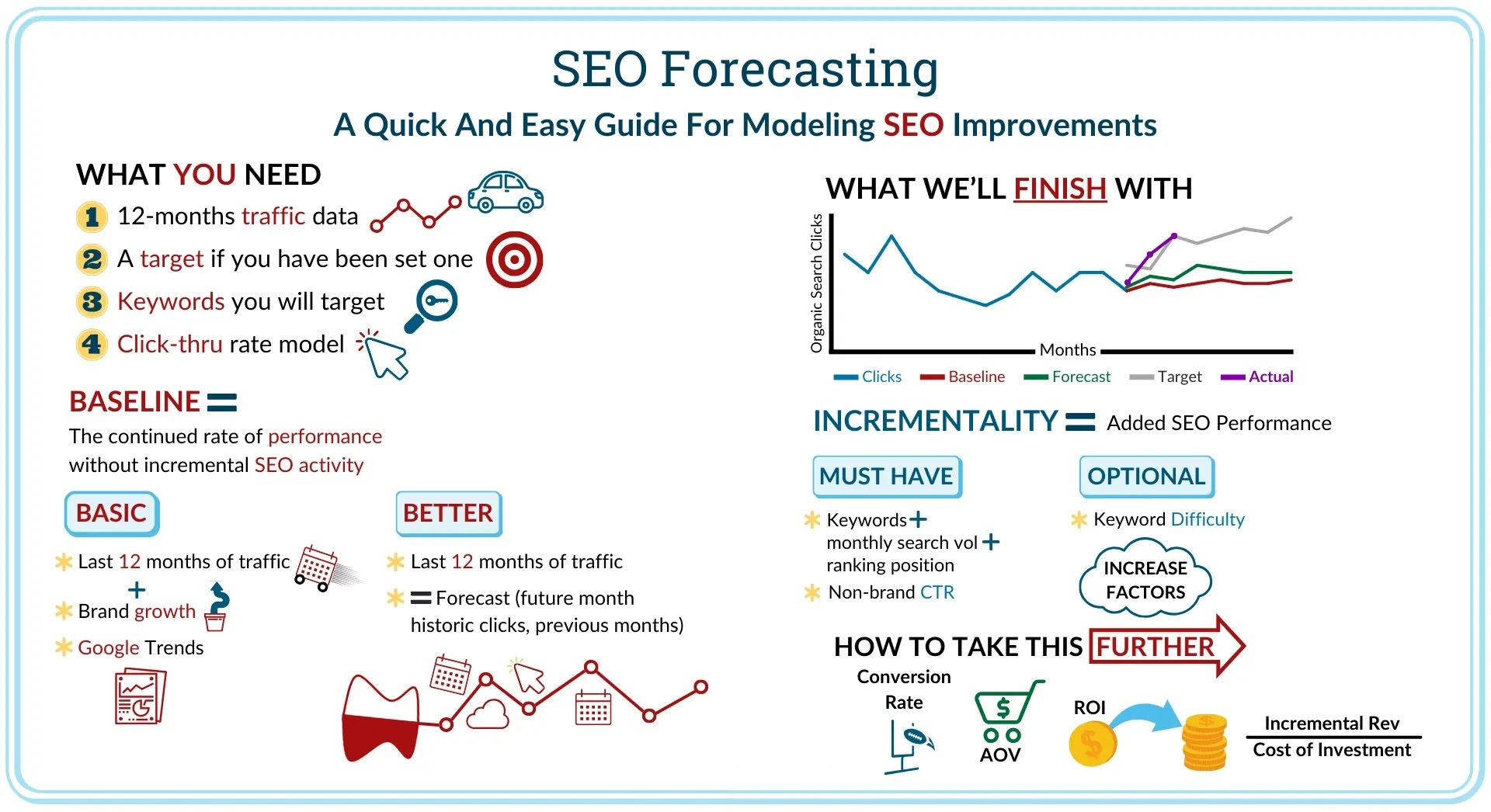
This is a perfectly reasonable question. Any forecasts can only be made after careful review of the project. To predict the likely results that can be achieved through technical optimisation, it is necessary to:
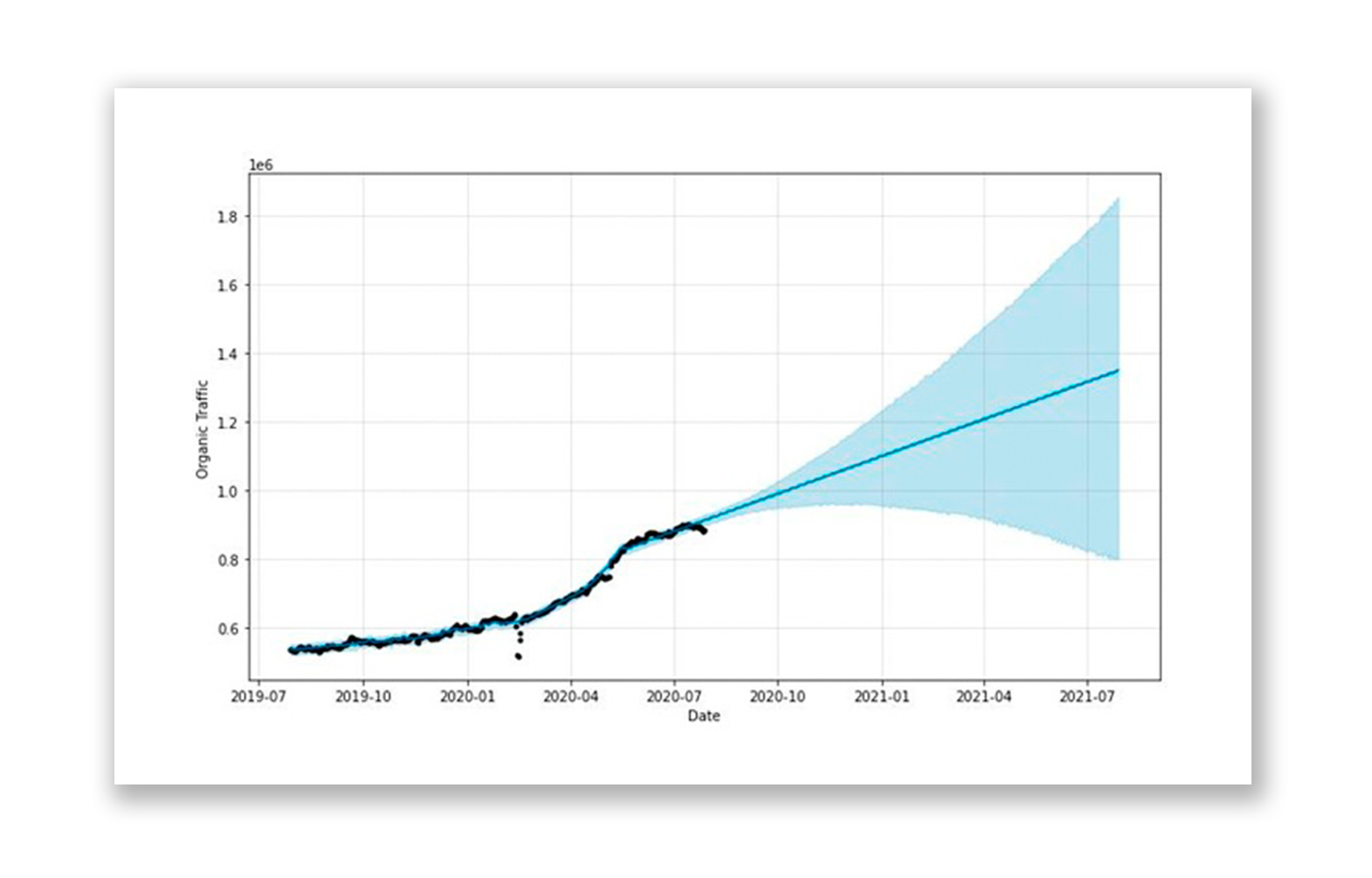
- Analyse historical data. Examining the website’s positions in historical retrospect, as well as organic traffic, conversions, and other metrics after previous SEO campaigns, allows you to identify trends and patterns in order to predict potential promotion results.
- Research your competitors. Studying the positions, strategies, and activity of competitors in organic search results helps you assess the effort required to achieve the desired positions. At the same time, it allows you to identify possible mistakes and learn from the unsuccessful decisions of others without repeating them.
- Conduct a technical audit of the website. A comprehensive technical audit allows you to identify problems and opportunities for improving your promotion strategy, giving you an idea of the growth potential after SEO optimisation.
- Analyse demand and trends. Researching search queries, traffic, and seasonality helps predict realistic traffic volumes after reaching target positions.
- Step-by-step planning and adaptation. Instead of a single forecast, it is better to build a step-by-step, realistic plan with regular analysis of interim results and strategy adjustments.
Data, a deep understanding of the specifics of the industry and the competitive environment, as well as the expert knowledge of SEO specialists, are key to making forecasts. Transparent communication about realistic expectations instead of guarantees is essential.
For example, we can make a fairly accurate prediction of CTR dynamics depending on changes in the site’s position over a certain period of time. The CTR (Click-Through Rate) directly depends on the position:
| A place at the top | CTR (%) |
| 1 | 31,93 |
| 2 | 14,45 |
| 3 | 8,70 |
| 4 | 5,71 |
| 5 | 4,02 |
The higher the page’s position in search results, the higher the CTR will be. Thus, in this case, we can predict that when the site enters the top 3, the CTR will increase by at least 3%. And when moving from third to first position, the CTR may increase 3.6 times, up to 31.9%. But even in this case, these are only approximate forecasts, not results that will be achieved with 100% certainty. This is not a guarantee!
It should be added that there are factors that neither website owners nor optimisers can influence, but which directly affect the website’s position and the effectiveness of promotion efforts:
- the overall reputation of the company whose website is being promoted;
- terms of the technical implementation of the tasks set;
- DDoS attacks or other external influences;
- competitor activity in the niche;
- new search engine updates, etc.
It is physically impossible to predict certain changes and the impact of certain factors. Therefore, even forecasts provided after careful analysis may prove to be inaccurate. And, moreover, there are no guarantees.
What is the point of making predictions if they are not accurate?
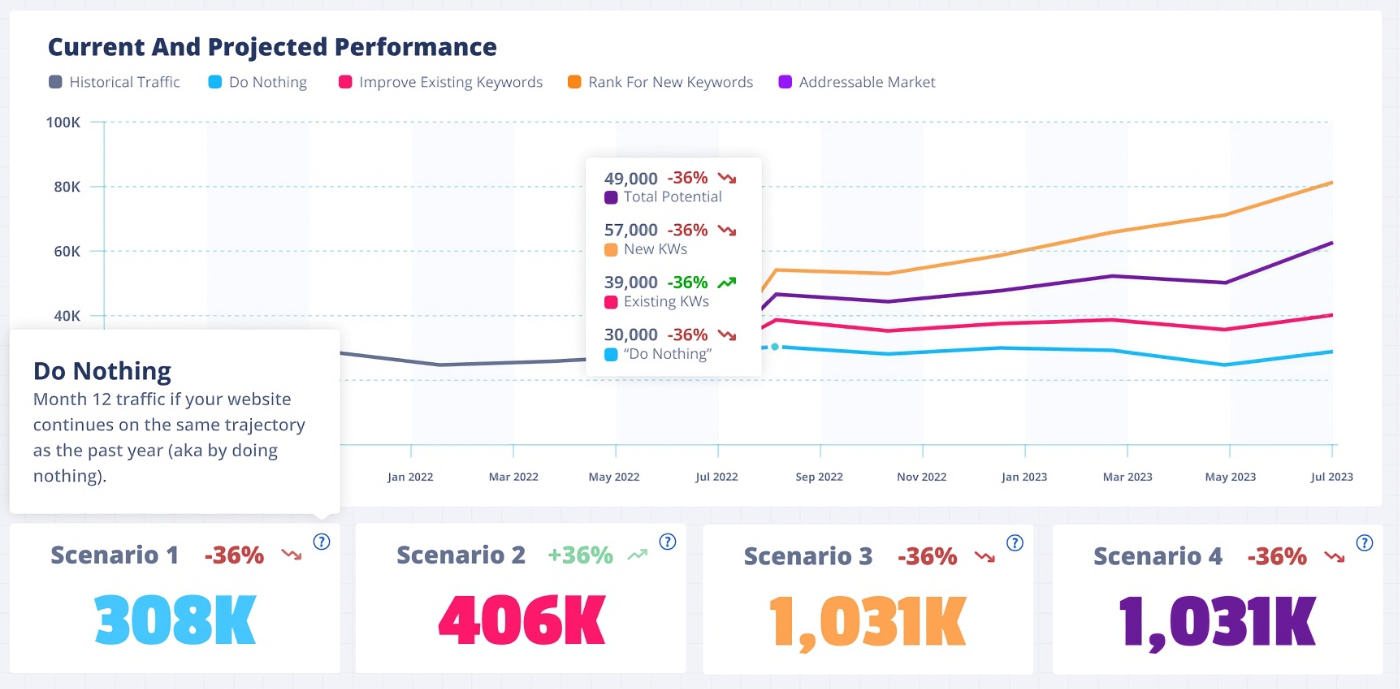
This is another perfectly reasonable question. In fact, forecasting in SEO is primarily necessary to obtain a benchmark for work and a realistic assessment of the site’s potential, to identify its strengths and weaknesses, and to develop an optimal promotion strategy.
Forecasting enables you to:
- develop a strategy and tactics for further optimisation;
- set realistic goals and expectations;
- measure campaign effectiveness and profitability with greater accuracy;
- adjust actions as necessary, taking changes into account.
Therefore, forecasting is indeed necessary. But not to guarantee a certain result, but to understand how this result can be achieved, how much time, effort, and money will be required. Otherwise, optimisation work will be carried out virtually blindly.
Instead of conclusions
Getting a guaranteed result is a perfectly reasonable desire for a website owner. However, any guarantees in SEO are purely manipulative in nature. Modern marketing relies on manipulation and the syndrome of missed opportunities in one way or another. Your task is not to succumb to its influence.
We hope that the information you have just learned will be useful to you and protect you from unnecessary expenses and wasted time. SEO promotion is a long-term process that is influenced by a huge number of factors. It is impossible to get instant results with it. Contextual advertising exists for this purpose. It is also impossible to guarantee a long-term effect, because even if you reach the top 3, you can quickly lose your position if you stop optimisation work while your competitors are actively working in this direction. Therefore, yes, the concepts of “SEO” and “guarantees” are indeed incompatible. But forecasting in SEO is a completely different matter.
This article was prepared by Igor Volov, promotion expert and CEO of the marketing agency Elit-Web.