Every business dreams of scaling, but not all know how a marketing strategy can help make it happen. In this case, we’ll share the story of a company that recognized the need for professional transformation.
WOODSUN — is a Ukrainian manufacturer of premium outdoor furniture made from solid wood. The company has been in production for 8 years, with the last 3 focused specifically on outdoor furniture.
- Year one — perfecting quality, materials, and service.
- Year two — testing collections and product range.
- Year three — promoting through exhibitions, events, and personal connections.
99% of the company’s sales came from offline contacts, referrals, and networking. A classic business model and a strong product — but lacking a marketing system for scalable growth.
After setting up a CRM system and experimenting with social media and ads, WOODSUN made a key decision:
“We can no longer rely solely on specific tools. We need a growth strategy.”
The founders approached us with clearly defined business goals:
- payback of the project in 3-4 years;
- growth by +20% annually;
- entry into international markets, Poland — the first stage.
When the goals are clear, we know what to focus on when developing a strategy. We built a marketing strategy that allowed the company to move strategically towards its ambitious goals
| How long did it take to develop the strategy? | 150 hours, 6 working weeks |
| What is the composition of the marketing strategy development team? | Head of Marketing Team, Head of PM Team, Head of Content Team, two operational marketers, an SMM marketer, Head of PPC, Facebook PPC specialist. |
| How was the result of the work used? | Independent implementation by specialists on the client’s side. |
Introduction
When WOODSUN came to us, the team already had:
- A strong product: solid wood outdoor furniture, handcrafted with custom designs.
- Active partnerships with HoReCa clients (hotels, restaurants, spa zones) in addition to the B2C segment.
- Well-organized logistics, short production timelines (up to 14 days), and a service-oriented approach.
- A clear value system: quality, aesthetics, durability, and customer care.
- A developed product catalog, a CRM system, and experience participating in industry events.
However, the brand was facing common challenges typical for small and medium-sized businesses in Ukraine:
- Lack of a structured marketing system.
- A blurred brand image compared to competitors.
- Social media and the website served more as a business card than as actual sales tools.
- An intention to enter international markets — but without a solid marketing foundation.
- Highly seasonal sales: peak in spring–summer, drop in autumn–winter.
Market analysis
Marketing should work as a business development system. But it is harder to do than to write. That’s why a large percentage of the marketing departments we audited were working on operational tasks that did not lead to strategic goals.
In this article, we discuss the strategic and operational tasks of marketing in more detail.
That’s why we always hold a strategic meeting with the client’s team before starting work to get a deeper understanding of the product, business ambitions and synchronise expectations.
We don’t put the preparation of a full brief on the client’s shoulders — on the contrary, we take this process upon ourselves. Before the meeting, our team prepares a brief based on all previous communication. And during the meeting, which usually lasts from one and a half to two and a half hours, we clarify key details with the client and discuss issues that require dialogue.
This allows us to dive into the work with a clear common vision, to be “on the same page” with the client and their team, which is especially important when several business representatives are involved in the discussion. And only then does our team move on to the next steps.
Analytics stage:
- We studied the Ukrainian market and assessed the potential for expansion into Europe.
- We conducted a detailed competitor analysis, including a “mystery shopper” study to experience firsthand what the end customer actually receives.
- We carried out a full communication audit of WOODSUN and identified all growth opportunities.
Global insights:
- The outdoor furniture market is far larger than it appears. It’s a multibillion-euro industry. One of the countries we researched alone had a market volume of €16 billion in 2024.
- Global growth is striking: driven by the outdoor lifestyle trend and increased investment in terraces, balconies, and garden spaces.
Ukrainian market:
- The garden furniture market in Ukraine exceeded €30 million in 2024.
- The annual growth rate during wartime conditions reached 11.71%.
- Key growth driver: the rising popularity of outdoor space design in private homes and HoReCa establishments.
The purpose of market analysis— is to understand the numbers, clearly define trends, and assess the company’s growth prospects across different countries. The data above is just a small portion of the insights we uncovered and organized — most importantly, we drew actionable conclusions from it.
We also explored market seasonality and the specific challenges of entering international markets.
The market analysis — like every other section of the research — is interconnected, forming a complete puzzle of a marketing strategy designed to answer the core question:
Want to get a clear plan of action? During the consultation, we will determine together which studies and stages will be most effective for your niche.
Competitor analysis
This section of the analysis allows you to see the real picture: what expectations and standards the niche has formed, where competitors are wasting resources and, conversely, what communication channels are still unfilled, what buying scenarios are working, and what needs to be transformed.
We agreed on 5 main competitors with the client, and then our team analysed their:
- websites;
- social media;
- communication;
- positioning;
- promotion channels.
What did we find?
1.Competitors’ product strategy
Brands are actively expanding their product range (accessories, textiles, lighting, BBQ areas, umbrellas) and focusing on active work with HoReCa.
Insight: This market still feels focused on offline sales. But major international players have already proven that a powerful digital ecosystem can offer customers a new experience and pleasant shopping conditions. In return, they benefit from reduced expenses for showrooms and less dependence on physical presence. This should be taken advantage of.
2. Positioning
We also discovered that none of the brands have claimed a clear leadership position. They all communicate using very similar messages and are barely distinguishable in the eyes of customers.
3. SMM and online promotion
All brands are active on social media, but visually and communicatively, they appear almost identical. There’s a lack of distinct brand patterns and tone of voice. Strong content strategies in reels or stories are missing entirely.
4. Websites
Most websites serve merely as a “showcase” without well-structured sales funnels. Poor user interaction, no automated replies, and delayed follow-up on inquiries are common industry-wide issues.
✅ Competitor analysis helps businesses understand exactly where and how to invest their efforts to generate maximum impact.
The tool that reveals the truth
Every company believes that its service is perfect.
But the truth comes out when you find yourself in the role of an ordinary customer who submits a request, asks questions, and waits for answers.
It is at this point — between expectation and reality — that the true test of a brand takes place.
We launched a “mystery shopper” study and became conditional customers of the major players in the outdoor market. What questions does the “mystery shopper” study answer?
👉 How do managers communicate, and what impression do they leave on the client?
👉 Are they true representatives of your brand, or just selling what they’ve been told?
👉 What values of the company can be inferred after communicating with a manager?
👉 How quickly are inquiries processed?
👉 What sales funnels are in place for clients who are not ready to make a decision right away?
We divided the “mystery shopper” research into two segments — and here’s what we discovered:
B2C-segment
- Most companies don’t respond the first time at all.
- There are no communication standards and “warming up” of leads.
- 2 out of 5companies didn’t respond to the inquiry even after several follow-ups.
Insight: Most business owners do not even realise what percentage of their companies’ total advertising budgets is wasted. Conducting a “mystery shopper” study allows you to see “gaps” not only in service, but also in the use of advertising budgets, and take quick action to prevent such waste.
B2B research
For the B2B test, we created a scenario involving a designer looking for outdoor furniture for a custom project. This allowed us to assess:
- how managers respond to non-standard requests;
- how willing they are to help and adapt;
- whether companies that claim to specialize in HoReCa truly deliver the level of service they declare on their websites.
The results of this test revealed valuable insights, which were later incorporated into the project’s marketing strategy.
Want to see your business through the eyes of your customers? Want to understand why your conversion rates aren’t growing? Sign up for a consultation with Solve Marketing, and we’ll show you what your system looks like from the perspective of a real buyer.
Audience analysis. Who are we creating a product for?
One of the key tasks of the section of the study entitled “audience analysis” is to provide as detailed a customer profile as possible. Knowing your audience is more than just determining their age, gender and income level.
This understanding of who makes decisions, what triggers influence choices, what path the customer takes to purchase, and what expectations and barriers arise at each stage.
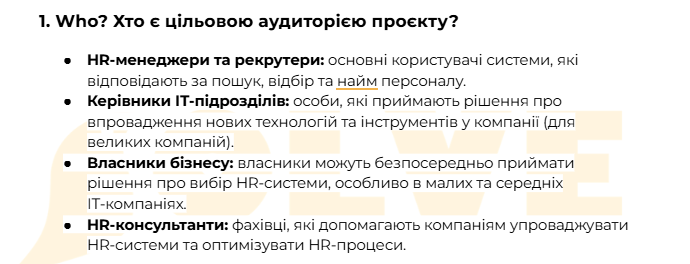
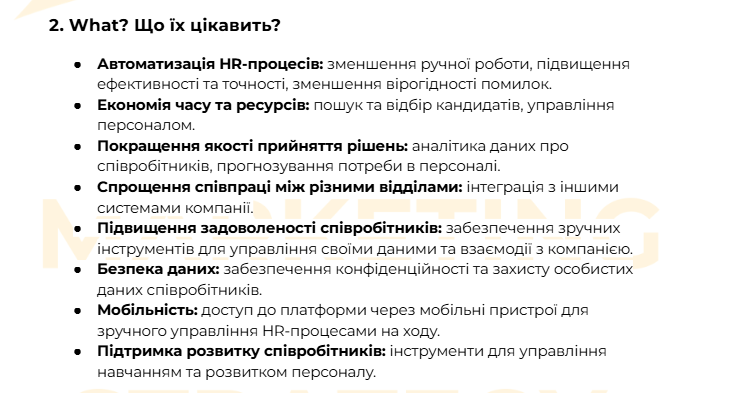
For WOODSUN, we:
👉 Conducted a full segmentation of B2C and B2B audiences.
👉 Built in-depth customer profiles using the 5W model (Who, What, Where, When, Why).
👉 Considered different behavioral scenarios, touchpoints, needs, motivations, doubt zones, and perceived value.
The insights from this audience analysis became the foundation for the next steps:
Insight: If marketing is perceived as advertising and social media, it will be difficult for companies to make a significant leap forward and move on to the next stage of development. Marketing is a full-fledged business function that links a clear understanding of customer segments, their needs, and the factors that influence their choices.
We also conducted a SWOT analysis.
This strategic tool allows you to clearly see:
🟡 what the brand’s strengths are;
🟡 where the vulnerabilities are;
🟡 what market opportunities can be used;
🟡 and what external risks need to be considered.
Why does the client choose you over others?
This question is answered by our author’s approach — the framework of choice factors.
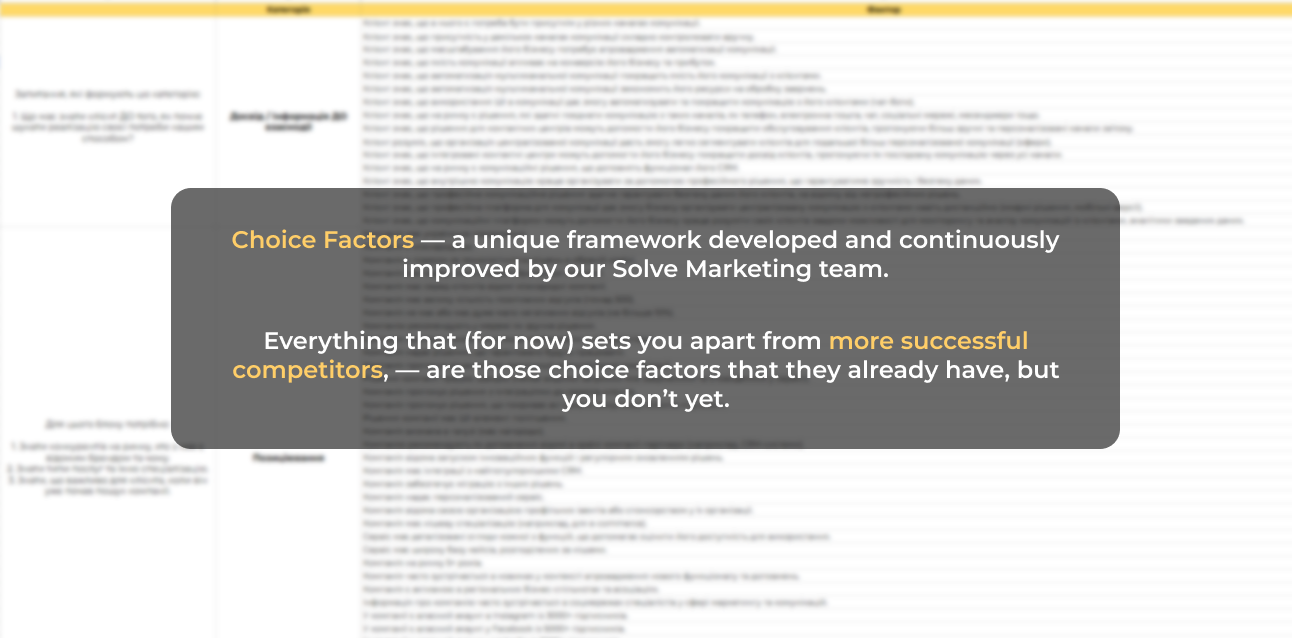
Each customer has their own unique set of triggers that influence their decision to purchase a product. Our task is to identify these triggers, understand their hierarchy, and adapt our marketing so that the brand hits the mark as accurately as possible.
We diagnose what is lacking in the brand experience. Then we create 100+ selection factors.
This allows us to:
👉 identify the blind spots in the business;
👉 strengthen the key competitive advantages;
👉 integrate the core buying factors into content, advertising, communication scripts, and the customer journey.
For more information about selection factors and how they affect the development of your business, see our article.
Positioning
Positioning is one of the tools of strategic marketing that helps a company occupy a vacant category in the customer’s mind.
Properly formulated positioning creates an association between the brand and the key values that the target audience expects to see.
We approach positioning development systematically. This is aided by in-depth analytics conducted at earlier stages:
- market analysis;
- competitive landscape review;
- target audience segmentation;
- in-depth study of choice factors (buying drivers).
This comprehensive process allows us to craft the exact slogan and brand message that clearly reflects the brand’s existing strengths and unique identity.
WOODSUN came to us with an initial positioning in place, but already at the briefing stage it became clear: the brand needed a refreshed, sharper direction.
Our goal was to transition WOODSUN from being perceived as “just a manufacturer of outdoor furniture” to a premium lifestyle brand associated with sophistication, quality, and emotional experience.
Our work resulted in an agreed positioning:
WOODSUN — Ukrainian manufacturer of designed solid wood furniture
To ensure that the positioning did not remain just a nice slogan in the presentation, we developed clear recommendations on how to integrate it into all the company’s business processes. This helped to create a sense of a single standard and a coherent brand identity at all points of contact.
Lead generation strategy
Before our collaboration began, WOODSUN had already made some attempts to launch advertising campaigns. However, without a clear system in place, those efforts didn’t deliver the expected results.
This is a common scenario for businesses that grow organically but haven’t yet established a structured performance marketing toolkit.
That’s why, when the time came to launch lead generation, the WOODSUN team decided to entrust us with the first test run — to avoid wasting time and budget on a trial-and-error approach.
A test launch allows you to:
- validate which hypotheses actually work;
- identify which audience segments respond best;
- optimize ad spend right from the start;
- build a real, data-driven sales funnel — not just a theoretical one.
As part of the project, we developed a basic lead generation strategy for WOODSUN: a detailed breakdown of the audience by funnel stages, seasonality forecasts, budgets, basic scenarios, and algorithms. This strategy would make it possible to hand over the launch to an external specialist.
But the WOODSUN team appreciated another important advantage:
“No one understands our product, market, competitors, audience, positioning, and even brand tone better than you.”
This allowed us to collect accurate analytical data for the final calibration of the strategy.
Final results
WoodSun found itself at a crossroads. On one hand — a strong product, experience, and satisfied clients. On the other — a growing feeling of “we could do more,” but no clear answer on how to move to the next level.
This required a comprehensive marketing system capable of transforming the chaos of isolated activities into an orderly, predictable, and manageable growth process.
This is not just a “set of recommendations.” We always finish our work on a strategy with a specific action plan: we write down in detail all the main steps that the brand must take to achieve its goals, structure the tasks, and set priorities.
The client is left with no sense of confusion — only a clear plan of action and confidence in the steps ahead.
Why work with us:
- We do not work superficially → we develop business development strategies and implement them on a turnkey basis.
- We do not offer a “set of services” → we develop a personalised action plan that, like a comfortable suit, is tailored to you.
- We do not believe in magic pills → only systematic work on strategic and operational tasks can lead to scaling.
If you’re a startup or a growing business ready to move from chaos to structure, from random wins to predictable results, from scattered tools to a unified marketing system — we’ll become your strategic partner.
Ready to grow your business?
During a free consultation, we will discuss what your personal marketing system will look like.