Business enquiry
Dva Bileta — Ukrainian service for booking and purchasing bus tickets for routes between Ukraine and Europe.
At the time of the request, the business did not have its own digital infrastructure:
- sales were made through intermediaries, cash registers, third-party platforms;
- There was virtually no own website as a channel for attracting customers.
- There is no single funnel, analytics, or lead quality control.
- scaling depended on manual processes rather than the system.
The business was selling, but it wasn’t managing demand, didn’t see the full picture of the customer journey, and didn’t have predictability in growth.
The client’s request was strategic:
- create your own website as the core of your business, rather than a secondary tool;
- lay the foundations for systematic SEO growth;
- prepare the platform for scaling paid traffic;
- make the service as user-friendly as possible for mobile users;
- закласти можливість зростання без операційного хаосу та постійних переробок.
💬 If your business currently depends on marketplaces, aggregators, recommendations, or manual sales, you essentially have no control over your demand, margins, or growth rate. In this model, having your own website is not about “image” but about building an independent channel for attracting customers, predictable income, and the ability to scale without increasing operational complexity.
I. Design: marketing as a foundation
The website design began with the formation of business logic and an understanding of the role the resource should play in the company’s growth.
Our team viewed the website as an integral part of the marketing and sales system, which should not only attract traffic, but also generate quality demand, increase trust and create a basis for scaling.
The marketer and analyst conducted in-depth preparatory work:
- researched user behaviour in the transport niche and decision-making logic;
- analysed search scenarios, seasonality and mobile patterns;
- assessed the competitive environment, website structures and approaches to SEO;
- identified potential scaling points and growth areas;
- formed the logic of the future funnel and key interaction scenarios.
Special attention was paid to understanding how users move from their initial query to booking: what doubts arise, what factors influence trust, where conversions are lost, and what interface elements can shorten the path to a decision.
The designer and developer were involved in the discussion from the very beginning. This allowed us to align marketing logic with real UX scenarios, technical limitations, and requirements for speed, scalability, and platform stability. The site architecture was designed with future load, functionality expansion, and integration with analytics and advertising systems in mind.
💬Design allows you to take into account customer behaviour, engagement channel requirements, and business operational constraints in advance so that the website is ready for advertising, SEO, and scaling without constant rework and budget losses.
II. Website structure: how managed demand is formed
The website was designed as a scalable platform capable of supporting traffic growth, expanding areas of focus, and connecting new channels of engagement.
At this stage, a “logical user path” is formed — from the first search query or advertising click to booking and contacting support. The focus was on reducing the number of steps to the target action without losing information and trust.
During the design process:
- logic for quick route search and offer filtering has been implemented;
- The user path to key actions — booking, enquiry, contact — has been optimised.
- designed a page hierarchy for indexing and organic growth;
- UX adapted to mobile scenarios, which dominate this niche;
- simplified navigation without losing functionality and content depth.
Separately, the team worked on information architecture: Each page has a clear role in the funnel — attracting, explaining, building trust, or converting, which allows you to manage user behaviour.
💬The structure of a website affects conversion, behavioural metrics, customer acquisition cost, and SEO growth potential. A well-designed architecture allows you to scale traffic, add new directions, and develop your product without constant reworking, loss of search rankings, and chaos in analytics.
III. Content: creating a long-term asset
At this stage, a content marketer joins the team and works closely with the SEO specialist and marketer to:
- They shape the semantic architecture of the project, taking into account real demand;
- Arrange pages into logical clusters of queries by direction, route, and user scenarios;
- Optimise URL structure, navigation and internal linking;
- Laying the groundwork for scaling new areas without changing the basic architecture;
- Synchronise SEO logic with future advertising campaigns and analytics.
Thanks to the “structure” stage, content marketers work with the behaviour and motivation of real users and understand the specific function that content performs in the funnel.
Special focus was placed on FAQs as a tool for SEO, conversion and traffic quality.
FAQ blocks:
- remove objections before contacting the operator;
- expand semantic coverage and visibility in search;
- filter out irrelevant traffic thanks to clear terms and explanations;
- increase conversion by reducing uncertainty.
💬 SEO and content are an investment in a long-term asset. They allow you to reduce dependence on advertising budgets, stabilise customer flow, increase margins and create real business value. In this logic, a website becomes not an expense, but a source of predictable growth.
V. Development, testing and launch
The implementation phase was structured as a systematic product assembly, where each technical component supports marketing logic, scalability, and business stability.
The developers implemented:
- responsive layout that works correctly on all types of mobile devices;
- optimised page loading speed to reduce bounce rates and improve SEO performance;
- stable operation of forms, booking scenarios and conversion points;
- proper integration with analytics for collecting data on user behaviour;
- technical readiness of the platform for launching advertising, SEO, and further scaling.
Before launch, the team conducted a comprehensive check: technical testing of stability and security; verification of UX scenarios on real user routes; additional optimisation of speed and load; control of the correctness of analytics, events and conversions collection.
The launch was a controlled process with monitoring of initial behavioural indicators to quickly identify growth points and potential bottlenecks.
💬 Technical quality directly affects search rankings, paid traffic effectiveness, conversion stability, and user trust. High-quality implementation reduces future rework costs, minimises technical risks, and allows you to scale your business without painful restructuring.
VI. Result: systematic growth of organic matter
After launch, the site began to steadily increase its organic visibility and generate its own demand flow without direct dependence on paid advertising..
According to Google Search Console (screenshot below):
- At the start of the project, organic traffic was minimal.
- Since May, steady gradual growth has been recorded.
- since August — sharp acceleration in dynamics;
- In autumn, the website reached tens of thousands of views and hundreds of targeted clicks every month.
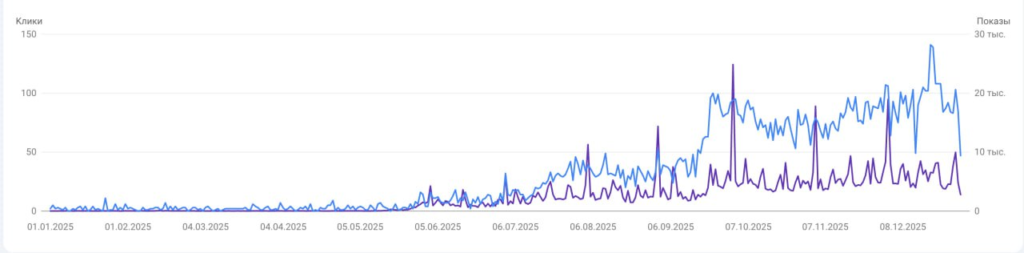
The graph shows not a random spike, but the result of systematic work. teams: correctly constructed SEO architecture; well-thought-out page structure; stable growth of relevant visibility in search results.
In fact, the website has become an independent channel for attracting customers, which:
- generates a constant flow of new requests;
- enhances the effectiveness of paid traffic;
- reduces the cost of customer acquisition in the long term;
- increases the overall capitalisation of the business.
💡 Website managed by a marketing specialist
In the Dva Bileta project, the website served as a comprehensive business tool:
- foundation for SEO scaling — systematic growth of organic demand;
- bases for paid traffic — stable advertising without chaos and budget losses;
- primary request qualification mechanism — filtering the quality of requests before they reach the manager;
- analytics and decision-making centre — data transparency and funnel manageability;
- strategic business asset that increases the company’s stability and capitalisation.
This result is the outcome of the coordinated work of the entire team: a marketer, SEO specialist, content marketer, designer, developer, and analyst, who worked as a single system rather than a group of separate contractors.
🎯 Free consultation with a marketing specialist
Want to create a managed channel for business growth?
Don’t spend your budget on design without a strategy — start by understanding what will work for your audience, niche, and sales model.
During a consultation with a marketing specialist, you will receive:
- A clear analysis of your current website or idea
- Understanding what business results a website can deliver
- Assessment of UX and content weaknesses
- Strategic model for launch and scaling
- Clear next steps and priorities
👉 Sign up for a free consultation with a Solve Marketing marketer — and together we will build a website that:
• reduces the risk of wrong decisions;
• improves lead quality;
• lays the foundation for scaling;
• allows you to control the outcome rather than just watching traffic.
The solution is not to monitor clicks, but to manage them.
Fill out the form and our marketing specialist will contact you to choose the best time for a consultation.