At the time of the request, Greenex Eco was already working on complex environmental projects and had a strong engineering base. At the same time, its marketing did not reflect the company’s actual level of expertise and did not provide a steady stream of requests.
Greenex Eco operates in the B2B segment with a long decision-making cycle, where several levels of responsibility are involved on the part of the client, and each project requires a high level of trust. In such an environment, marketing must perform not only a communicative function, but also an explanatory and analytical one — forming a clear understanding of the value of the company’s solutions.
That is why the Solve Marketing team began working on a comprehensive marketing strategy, which involved a thorough analysis of the market, the competitive environment, the current state of the project, and the company’s business goals.
The strategy became the basis for decision-making, priority setting and further planning of marketing activities.
| How long did it take to develop the strategy? | 150 hours, 6 working weeks |
| What is the composition of the marketing strategy development team? | Head of Marketing Team, Head of PM Team, Head of Content Team, Operational Marketer, Content Marketer, Head of PPC Department, PPC Facebook, Editor. |
| How were the results of the work used? | Independent implementation by the client |
Greenex Eco project input data
Greenex Eco is a company specialising in comprehensive engineering solutions in the field of air purification and hazardous waste management. The project works with industrial enterprises for which environmental compliance, technological reliability and service support are critical factors when choosing a contractor.
The company implements turnkey solutions, from analysis and design to implementation, service and after-sales support. A separate area of activity is work on projects financed through grants and international programmes, within which Greenex Eco acts as a technical implementer of solutions.
Key project characteristics
🟡Segment: B2B, industrial enterprises.
🟡Product type: engineering environmental solutions, and technologies.
🟡Agreement cycle: long, involving several stakeholders.
🟡Form of cooperation: individual projects, solutions for specific technical requirements.
Initial state of marketing
At the time of launch, the company:
- received a limited number of incoming requests;
- had a limited online presence that did not reflect the depth of expertise and scale of projects implemented;
- did not use marketing as a systematic tool for growth, but rather as a supporting function.
Business objectives of the project
Greenex Eco’s main business goal was to scale the company’s revenue from the current level to 150 million hryvnia per year, thanks to:
- increasing in the number of independent appeals;
- enhancing brand awareness among the target audience;
- building trust in the company as a reliable technology partner.
This input data formed the basis for the subsequent analytical stage and determined the requirements for the depth and structure of the marketing strategy.
Market analysis
Market analysis is the first analytical stage in developing a marketing strategy. Its objectives are to form an objective view of the market context in which the company operates and to identify external factors that influence demand, customer behaviour and competitive dynamics.
Market context
The market for industrial air purification and hazardous waste management technologies in Ukraine is shaped by:
- strengthening environmental regulation;
- adaptation of Ukrainian standards to the requirements of the European Union;
- high level of wear and tear of industrial capacity;
- the need to modernise production facilities in order to reduce environmental risks.
Greenex Eco operates in a market where decisions to implement environmental technologies are strategic in nature and directly related to business security, regulatory compliance and long-term financial implications.
Key market trends
The analysis identified a number of trends that determine market development:
- growing demand for customised engineering solutions tailored to specific industries and production processes;
- increasing environmental responsibility in business, especially among large industrial enterprises;
- interest in technologies that enable the reduction of energy consumption and operating costs;
- the growing role of service support and post-project support as decision-making factors.
Regulatory environment
Particular attention was paid to the analysis of the regulatory framework. Tighter requirements for emissions control and reporting create conditions under which:
- companies are forced to invest in modern purification systems;
- there is a growing demand for technologically complex solutions with proven effectiveness;
- the reliability of the supplier and their expertise become critical.
Seasonality and demand
Demand for air purification solutions has moderate seasonality, but investment decisions are usually made in advance, within the framework of companies’ budget planning. This affects:
- timing of marketing activities;
- planning communications with potential customers;
- selection of communication channels.
The results of the market analysis made it possible to define the boundaries for further research into the competitive environment and to formulate requirements for Greenex Eco’s positioning.
Competitive environment analysis
The main goal of this stage is to form a comprehensive understanding of the market, other players’ approaches to communication, promotion, and building trust among the target audience.
During this stage, our Solve Marketing team worked in various professional roles, which allowed us to examine competitors from several management and marketing perspectives:
- a content marketer, who evaluated communication logic, messages, content structure, expertise and trust;
- an operational marketer who analysed engagement channels, lead generation mechanics, website structure, the presence of conversion elements, and promotion tools.
This approach makes it possible to obtain a comprehensive picture of the competitive landscape rather than limiting oneself to evaluating individual instruments.
The following was examined as part of the competitive analysis:
- company websites (structure, navigation, positioning, conversion blocks);
- social networks (activity, content types, regularity, focus);
- brand communication (offers, value proposition, customer focus);
- visual presentation (design, consistency, relevance to the B2B segment);
- promotion tools (paid and organic channels, participation in industry events, partnerships).
Online and offline activities were considered separately, including competitors’ participation in exhibitions, conferences, specialised events, and professional communities.
General observations
The analysis showed that a significant portion of companies in the market:
- has a strong technical or manufacturing base;
- at the same time, it uses marketing in a fragmented manner;
- does not systematise communication and does not build a consistent customer journey from initial contact to conversion.
These observations formed the basis for further analysis of the project itself and the formation of our team’s expert conclusions.
The results of the competitive environment analysis made it possible to clearly identify areas of opportunity and set guidelines for further strategic decisions.
Want to understand what your competitive landscape looks like?
If it is important for you to objectively assess the state of your business’s marketing and understand which direction to move in next, sign up for a free consultation with our marketing specialist.
Analysis of the Greenex Eco project
The project analysis was conducted to assess the current state of the company’s marketing assets and determine how well they align with business goals and target audience expectations. At this stage, our team focused on the actual state of the brand’s online presence and the quality of communication.
Areas of analysis
The following was examined as part of the project analysis:
- company website (structure, navigation, service delivery logic, availability of conversion elements);
- social networks (activity, content types, relevance to the B2B segment);
- presentation materials (structure, value proposition, consistency with positioning);
- the company’s reputation online (mentions, open sources, information field).
Special attention was paid to communication consistency between different channels and the relevance of materials to the expectations of a B2B audience with a long decision-making cycle.
The results of the project analysis formed the basis for recommendations and further development of the lead generation model.
Free consultation with a marketing specialist
We will conduct a consultation to assess the current state of marketing and possible areas for growth.
Lead generation analysis
Objective: assess how the flow of incoming enquiries is formed, which channels are involved in attracting potential customers, and at which stages limitations for scaling arise.
At the start of our work, we noted that the number of enquiries remained limited, and the process of attracting customers was not systematic or predictable.
The following was processed during this stage:
- current channels for receiving requests;
- the logic of the customer’s journey from initial contact to application;
- the role of the website and presentation materials in decision-making;
- the presence or absence of tools for fixing and processing leads.
Separately, we analysed the extent to which marketing assets are ready for traffic scaling and whether they can effectively convert interested audiences into enquiries.
Test launch of advertising
After completing the analytical stage and forming basic recommendations, a test launch of advertising campaigns was implemented for the Greenex Eco project. The format and depth of the launch were determined individually, taking into account the project’s readiness for paid traffic acquisition.
🟡 The test launch was seen as part of the strategic process and a source of additional data for further decisions.
Choice factors (Solve Marketing framework)
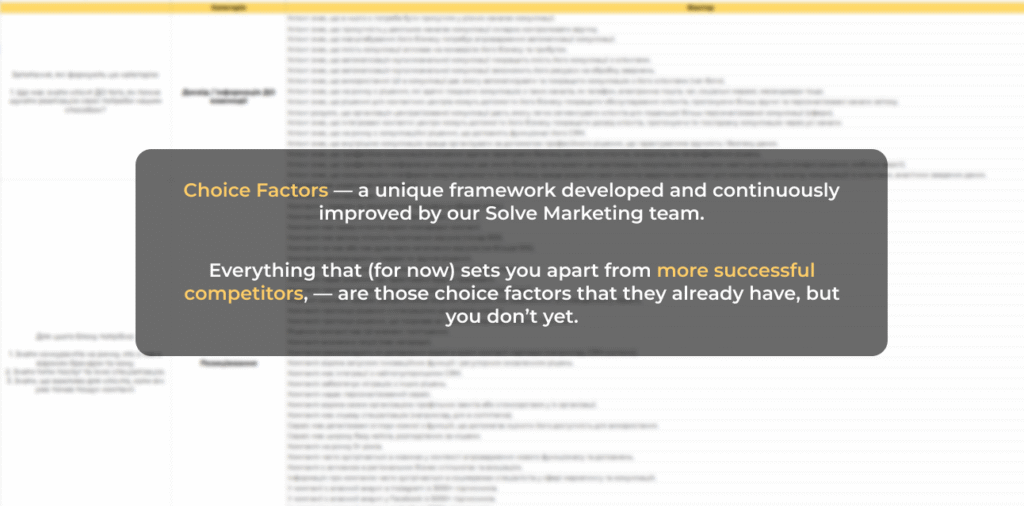
Choice factors are a key methodological element in our approach to strategy development. At this stage, we focus on identifying the real reasons why customers choose a contractor in the field of complex B2B engineering solutions.
Approach to the formation of choice factors
The choice factors were based on:
- results of market and competitive environment analysis;
- analysis of the project and current marketing assets;
- the specifics of the B2B market with its long decision-making cycle;
- features of the decision-making process in industrial companies.
More than 5 experts were involved in working on the choice factors, which made it possible to take into account both marketing and operational decision-making logic.
Result of the stage
As part of the project for Greenex Eco, more than 120 choice factors were developed, which:
- structure the argumentation of the company’s value;
- form the basis for positioning and communication;
- used in content, presentation materials, on the website and in lead generation;
- help align marketing messages with actual customer expectations.
This stage provides the basis for systematic and consistent communication at all levels of interaction with potential customers.
Let’s discuss how a strategic approach can work for your business. Sign up for a free consultation with a Solve Marketing marketer.
Marketing strategy and implementation stages
The marketing strategy for Greenex Eco was developed based on previous stages of analysis and taking into account the company’s business objectives, market specifics, and the peculiarities of the decision-making process in the B2B segment.
The strategy covers the long-term logic of marketing development and defines the sequence of actions necessary to generate a stable flow of enquiries and increase brand awareness.
Strategy structure
- brand positioning based on choice factors;
- identifying priority communication channels;
- developing a unified approach to interacting with potential customers;
- preparation of marketing assets for scaling;
- planning tools to achieve business goals.
Stages of implementation
The implementation of the strategy was structured in stages, which allows for:
- maintaining process control;
- gradually implementing changes;
- adapting decisions to actual results.
The logic of implementation
Each stage of the strategy is linked to the previous one and forms the basis for the next. This approach makes it possible to not view marketing as a set of separate activities, but to work with it as a managed system.
A marketing strategy is a tool for further decisions and practical implementation of changes to achieve the business goals of the project.
Strategy tools and strategic tasks block
To achieve the project’s business goals, 17 key areas of work were identified, which form a comprehensive marketing system. Each tool has its own role in the overall logic of attracting, retaining and converting potential customers.
Block of strategic tasks
In parallel with the development of tools, more than 50 strategic tasks were developed, detailing how exactly each area should be implemented in practice.
Strategic objectives:
🟡structure the implementation of marketing solutions;
🟡define priorities and sequence of actions;
🟡serve as a basis for planning resources and deadlines;
🟡enable the client’s team or remote marketing department to work with a unified logic.
Format for further cooperation
The marketing strategy is not considered a separate document. Once it is complete, the Solve Marketing team presents the solutions they have developed, explains the logic behind their choice of tools, and provides advice on how to implement the recommendations correctly.
Depending on the needs of the project, there are two possible formats for further interaction:
- support and consultation from a marketing specialist during strategy implementation;
- working in the format of a remote marketing department with step-by-step implementation of the strategy, together with the client’s team.
According to Solve Marketing’s internal statistics, approximately 85% of clients proceed to further cooperation in the form of implementation and systematic marketing management after the strategy has been developed.
If you want to understand where to start with systematic marketing in your business, sign up for a free consultation with a Solve Marketing specialist.